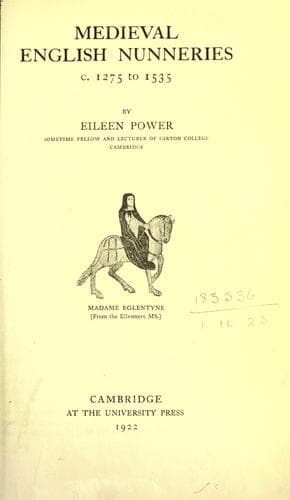
Medieval English Nunneries c. 1275 to 1535Power, Eileen
History
Medieval English Nunneries c. 1275 to 1535
Power, Eileen
Convents -- England; Monastic and religious life of women -- History
To say that the convents were the refuge of the gently born is not to say
that there was no admixture of classes within them. The term gentleman was
becoming more comprehensive in the later middle ages. It included the
upper class proper, the families of noble birth; and it included also the
country gentry. The convents were probably at first recruited almost
entirely from these two ranks of society, and a study of any collection of
medieval wills shows how large a proportion of such families took
advantage of this opening for women. A phrase will sometimes occur which
shows that it was regarded as the natural and obvious alternative to
marriage. Sir John Daubriggecourt in 1415 left his daughter Margery 40
marks, "if she be wedded to a worldly husband, and if she be caused to
receive the sacred veil of the order of holy nuns" ten pounds and twenty
shillings rent[12], and Sir John le Blund in 1312 bequeathed an annuity to
his daughter Ann, "till she marry or enter a religious house"[13]. The
anxiety of the upper classes to secure a place for their children in
nunneries sometimes even led to overcrowding. At Carrow the Prioress was
forced to complain that "certain lords of England whom she was unable to
resist because of their power" forced their daughters upon the priory as
nuns, and in 1273 a papal bull forbade the reception of more inmates than
the revenues would support[14]. Archbishop William Wickwane addressed a
similar mandate to two Yorkshire houses, Wilberfoss and Nunkeeling, which
public rumour had informed him to be overburdened with nuns and with
secular boarders "at the instance of nobles"[15]; and in 1327 Bishop
Stratford wrote to Romsey Abbey that the house was notoriously burdened
with ladies beyond the established number, and that he had heard that the
nuns were being forced to receive more "damoyseles" as novices, which he
forbade without special licence[16]. A very strong personal connection
must in time have been established between a nunnery and certain families
from which, in each generation, it received a daughter or a niece and her
dower. Such was the connection between Shouldham and the Beauchamps[17]
and between Nunmonkton and the Fairfaxes[18]. A close link bound each
nunnery to the family of its patron. Thus we find a Clinton at Wroxall and
a Darcy at Heynings; nor is it unlikely that these noble ladies sometimes
expected privileges and homage more than the strict equality of convent
life would allow, if it be permissible to generalise from the behaviour of
Isabel Clinton[19] and from the fact that Margaret Darcy received a rather
severe penance from Bishop Gynewell in 1351 and a special warning against
going beyond the claustral precincts or speaking to strangers[20], while
in 1393 there occurs the significant injunction by Bishop Bokyngham that
no sister was to have a room to herself except Dame Margaret Darcy
(doubtless the same woman now grown elderly and ailing) "on account of the
Public-domain text, read in full here on John Shaqi.
Reviews
Reviews
No reviews yet
Be the first to share your thoughts on this work.
Join the Discussion
Join the discussion
Sign in to leave a comment or review.
Sign InorCreate an account