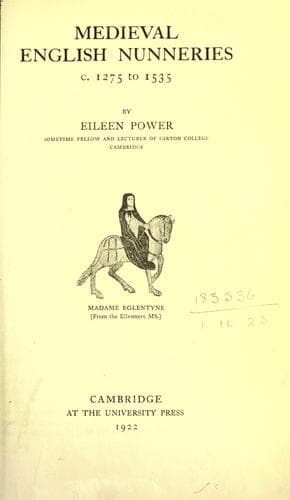
Medieval English Nunneries c. 1275 to 1535Power, Eileen
History
Medieval English Nunneries c. 1275 to 1535
Power, Eileen
Convents -- England; Monastic and religious life of women -- History
"We have received your letter," writes Peckham, "in favour of the
Prioress and Convent of Stratford, urgently begging us to moderate our
purpose concerning a certain burden which is alleged to be threatening
them from us, on account of the insupportable weight and the poverty
of the house and the deformity of the person, whom we have presented
to them for admission. Concerning which we would have you know that
already in the lifetime of your predecessor of good memory, we had
ordered them to receive that same person and for two years we
continued to believe that they would yield to our wishes in the
matter, yet without burden to themselves, by the provision of the
parents of the said little maid; especially seeing that never yet have
we been burdensome to any monastery making a truthful plea of
indigence. We believe that what they allege about deformity would be
an argument in favour of our proposal; would that not only these women
of Stratford, concerning whom so many scandals abound, but also all
who so immodestly expose themselves to human conversation and company,
were or at least appeared notable for such deformity that they should
tempt no one to crime! We have moreover heard that the greater part of
the convent would willingly consent to the reception of the girl, were
they not hindered by the malice of the prioress; nevertheless, lest we
should seem deaf to your entreaties, we suspend the whole business
until we come to London, to ascertain how our purpose may be carried
out without notable damage to them[602]."
The Archbishop had his way however; for eleven years later the will of
Robert le Bret was enrolled in the Court of Husting and contained a legacy
of rents on Cornhill "to Isabella his daughter, a nun of Stratford"[603].
Peckham also wrote in a tone of strained patience to the nuns of Castle
Hedingham, who had refused to receive Agnes de Beauchamp, warning them
that besides incurring severe punishment at his own hands, further
obstinacy would offend the Queen of England, at whose instance he had
undertaken the promotion of the said Agnes[604]. The Prioress of Catesby
was equally troublesome and as late as 1284 the Archbishop wrote
reprimanding her for her inconstancy and feigned excuses, because, after
promising to receive the daughter of Sir Robert de Caynes and after
repeated requests on his part that they should admit the girl, she and her
nuns had written asking to be allowed to admit another person in her
stead[605].
Public-domain text, read in full here on John Shaqi.
Reviews
Reviews
No reviews yet
Be the first to share your thoughts on this work.
Elsewhere in the archive
Join the Discussion
Join the discussion
Sign in to leave a comment or review.
Sign InorCreate an account