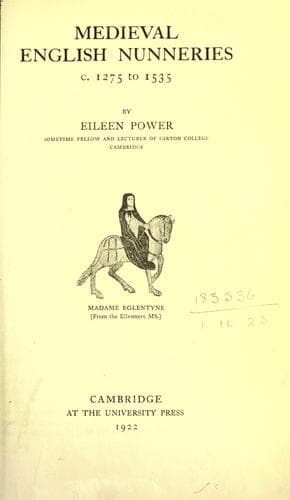
Medieval English Nunneries c. 1275 to 1535Power, Eileen
History
Medieval English Nunneries c. 1275 to 1535
Power, Eileen
Convents -- England; Monastic and religious life of women -- History
Real poverty often nerved the nuns to such bold resistance. In the
Register of Bishop Grandisson of Exeter there is a letter from Polsloe
Priory, written in 1329 and addressed to Queen Philippa, on the subject of
a certain Johanete de Tourbevyle[606], whom she had requested the nuns to
receive as a lay sister. Written in the French of their daily speech, with
no attempt at formal phraseology, their naive plea still rings with the
agitation of the "poor and humble maids," torn between anxiety not to
burden their impecunious house, and fear of offending the new-made Queen
of England:
To their very honourable and very powerful and redoubtable lady, my
lady Dame Philippa, by the grace of God queen of England, etc., her
poor and humble maids, the nuns of Polsloe, in all that they may of
reverence and honour; beseeching your sweet pity to have mercy on our
great poverty. Our very noble dame, we have received your letters, by
the which we understand that it is your will that we receive Johanete
de Tourbevyle among us as sister of the house, to take the dress of a
nun in secular habit. Concerning the which matter, most debonair lady,
take pity upon us, if it please you, for the love of God and of His
mother. For certainly never did any queen demand such a thing before
from our little house; though mayhap they be accustomed to do so from
other houses, founded by the kings and holding of them in chief; but
this do not we, wherefore it falls heavily upon us. And if it please
your debonair highness to know our simple estate, we are so poor (God
knows it and all the country) that what we have suffices not to our
small sustenance, who must by day and night do the service of God,
were it not for the aid of friends; nor can we be charged with
seculars without reducing the number of us religious women, to the
diminution of God's service and the perpetual prejudice of our poor
house. And we have firm hope in God and in your great bounty that you
will not take it ill that this thing be not done to the peril of our
souls; for to entertain and to begin such a new charge in such a small
place, a charge which would endure and would be demanded for ever
afterwards, would be too great a danger to your soul, my Lady, in the
sight of God, wherefrom God by His grace defend you! Our most blessed
Lady, may God give you a long and happy life, to His pleasure and to
the aid and solace of ourselves and of other poor servants of God on
earth; and we should have great joy to do your behests, if God had
given us the power[607].
Public-domain text, read in full here on John Shaqi.
Reviews
Reviews
No reviews yet
Be the first to share your thoughts on this work.
Elsewhere in the archive
Join the Discussion
Join the discussion
Sign in to leave a comment or review.
Sign InorCreate an account