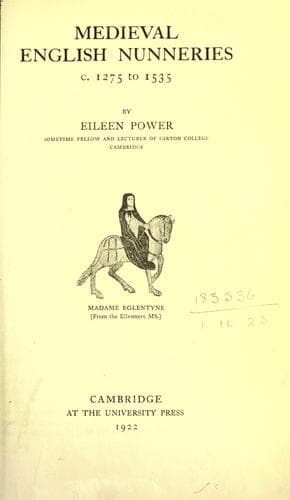
Medieval English Nunneries c. 1275 to 1535 — John Shaqi
Medieval English Nunneries c. 1275 to 1535Power, Eileen
History
Medieval English Nunneries c. 1275 to 1535
Power, Eileen
Convents -- England; Monastic and religious life of women -- History
This social amalgamation between the country gentry and the "new
gentlemen," who had made their money in trade, was naturally reflected in
the nunneries. The wills of London burgesses, which were enrolled in the
Court of Husting, show that the daughters of these well-to-do citizens
were in the habit of taking the veil. There is even more than one trace of
the aristocratic view of religion as the sole alternative to marriage.
Langland, enumerating the good deeds which will win pardon for the
merchant, bids him "marie maydens or maken hem nonnes"[26]. At Ludlow the
gild of Palmers provided that:
If any good girl of the gild of marriageable age, cannot have the
means found by her father, either to go into a religious house or to
marry, whichever she wishes to do, friendly and right help shall be
given her out of our common chest, towards enabling her to do
whichever of the two she wishes[27].
Similarly at Berwick-on-Tweed the gild "ordained by the pleasure of the
burgesses" had a provision entitled, "Of the bringing up of daughters of
the gild," which ran: "If any brother die leaving a daughter true and
worthy and of good repute, but undowered, the gild shall find her a dower,
either on marriage or on going into a religious house"[28]. So also John
Syward, "stockfisshmongere" of London, whose will was proved at the Court
of Husting in 1349, left, "To Dionisia his daughter forty pounds for her
advancement, so that she either marry therewith or become a religious at
her election, within one year after his decease"[29]; and William Wyght,
of the same trade, bequeathed "to each of his daughters Agnes, Margaret,
Beatrix and Alice fifty pounds sterling for their marriage or for entering
a religious house" (1393)[30]; while William Marowe in 1504 bequeathed to
"Elizabeth and Katherine his daughters forty pounds each, to be paid at
their marriage or profession"[31]. Sometimes, however, the sound burgess
sense prevailed, as when Walter Constantyn endowed his wife with "the
residue of his goods, so that she assist Amicia, his niece, ... towards
her marriage or to some trade befitting her position"[32].
Public-domain text, read in full here on John Shaqi.
Reviews
Reviews
No reviews yet
Be the first to share your thoughts on this work.
Join the Discussion
Join the discussion
Sign in to leave a comment or review.
Sign InorCreate an account