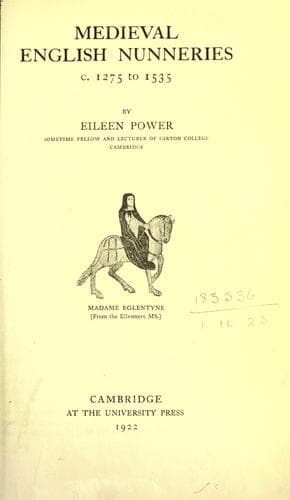
Medieval English Nunneries c. 1275 to 1535Power, Eileen
History
Medieval English Nunneries c. 1275 to 1535
Power, Eileen
Convents -- England; Monastic and religious life of women -- History
The mixture of classes must have been more frequent in convents which were
situate in or near a large town, while the country gentry had those lying
in rural districts more or less to themselves. The nunnery of Carrow, for
instance, was a favourite resort for girls of noble and of gentle birth,
but it was also recruited from the daughters of prosperous Norwich
citizens; among nuns with well-known county names there were also ladies
such as Isabel Barbour, daughter of Thomas Welan, barber, and Joan his
wife, Margery Folcard, daughter of John Folcard, alderman of Norwich, and
Catherine Segryme, daughter of Ralph Segryme, another alderman; the latter
attained the position of prioress at the end of the fifteenth century[33].
These citizens, wealthy and powerful men in days when Norwich was one of
the most important towns in England, probably met on equal terms with the
country gentlemen of Norfolk, and both sent their daughters with handsome
dowries to Carrow. The nunneries of London and of the surrounding district
contained a similar mixture of classes, ranging from some of the noblest
ladies in the land to the daughters of city magnates, men enriched by
honourable trade or by the less honourable capitalistic ventures of the
king's merchants. The famous house of Minoresses without Aldgate
illustrates the situation very clearly. It was always a special favourite
of royalty; and the storm bird, Isabella, mother of Edward III, is by some
supposed to have died in the order. She was certainly its constant
benefactress[34] as were Thomas of Woodstock, Duke of Gloucester and his
wife, whose daughter Isabel was placed in the nunnery while only a child
and eventually became its abbess[35]. Katherine, widow of John de Ingham,
and Eleanor Lady Scrope were other aristocratic women who took the veil at
the Minories[36]. But this noble connection did not prevent the house from
containing Alice, sister of Richard Hale, fishmonger[37], Elizabeth,
daughter of Thomas Padyngton, fishmonger[38], Marion, daughter of John
Charteseye, baker[39], and Frideswida, daughter of John Reynewell,
alderman of the City of London[40], girls drawn from the _elite_ of the
burgess class. An investigation of the wills enrolled in the Court of
Husting shows the relative popularity of different convents among the
citizens of London. Between the years 1258 and the Dissolution, 52 wills
contain references to one or more nuns related to the testators[41]. From
these it appears that the most popular house was Clerkenwell in Middlesex,
which is mentioned in nine wills[42]. Barking in Essex comes next with
eight references[43], and St Helen's Bishopsgate with seven[44]; the house
of Minoresses without Aldgate is five times mentioned[45], Haliwell[46] in
London and Stratford-atte-Bowe[47] outside, having five and four
references respectively, Kilburn in Middlesex three[48], Sopwell in
Hertfordshire two[49], Malling[50] and Sheppey[51] in Kent two each. Other
Public-domain text, read in full here on John Shaqi.
Reviews
Reviews
No reviews yet
Be the first to share your thoughts on this work.
Join the Discussion
Join the discussion
Sign in to leave a comment or review.
Sign InorCreate an account