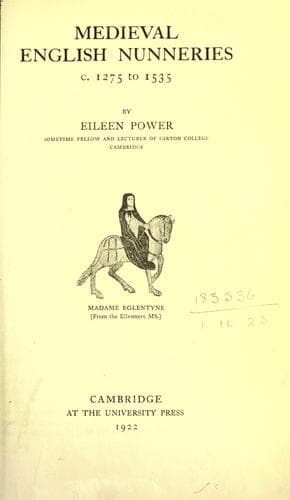
Medieval English Nunneries c. 1275 to 1535Power, Eileen
History
Medieval English Nunneries c. 1275 to 1535
Power, Eileen
Convents -- England; Monastic and religious life of women -- History
This comprehensive catalogue gives some indication of the losses which a
house would suffer from reckless grants. The sale of timber and the
alienation or pawning of plate were other expedients to which the nuns
constantly resorted and which were as constantly prohibited by the
bishops[679]. The Prioress of Nunmonkton in 1397, "alienated timber in
large quantities to the value of a hundred marks"[680]; the cutting down
of woods was charged against the Prioresses of Heynings, Harrold, Langley,
Gracedieu, Catesby and Ankerwyke at Alnwick's visitations; at Langley it
was moreover found that the woods were not properly fenced in after the
trees were felled and so the tree-stumps were damaged[681]; the necessity
for raising the money was sometimes specifically pleaded, as at Markyate,
where a small wood had been sold "to satisfy the creditors of the
house"[682]. These sales of timber were a favourite means of obtaining
ready money; but too often the loss to the house by the destruction of its
woods far outweighed the temporary gain and the Abbeys of St Mary's
Winchester and Romsey made special mention of this cause of impoverishment
in the middle of the fourteenth century[683]. The alienation or pawning of
plate and _jocalia_ was often resorted to in an extremity. At Gracedieu in
1441 the jewels of the house had been pawned without the knowledge of the
convent, so that the nuns (as one of them complained) had not one bowl
from which to drink[684]; the next year it was asserted that the Prioress
of Catesby "pawned the jewels of the house for ten years, to wit one cup
for the sacrament, which still remained in pawn, and also other pieces of
silver"[685]. When Bishop Longland visited Nuncoton in 1531 he found that
the Prioress had in times past sold various goods belonging to her house,
"viz. a bolle ungilte playn with a couer, oon nutt gilte with a couer, ij
bolles white without couers, oon Agnus of gold, oon bocle of gold, oon
chalice, oon maser and many other things"[686]; and in 1436 it was ordered
that the chalices, jewels and ornaments of St Mary's Neasham, which were
then in the hands of sundry creditors, were to be redeemed[687]. In the
case of Sinningthwaite in 1534 the convent was in such a reduced state
that Archbishop Lee was actually obliged to give the nuns licence to
pledge jewels to the value of L15[688]. The charge of pawning or selling
jewels for their own purposes was often made against prioresses whose
conduct in other ways was bad; for instance against Eleanor of Arden in
1396[689], Juliana of Bromhale in 1404[690], Agnes Tawke of Easebourne in
1478[691] and Katherine Wells of Littlemore in 1517[692].
Public-domain text, read in full here on John Shaqi.
Reviews
Reviews
No reviews yet
Be the first to share your thoughts on this work.
Elsewhere in the archive
Join the Discussion
Join the discussion
Sign in to leave a comment or review.
Sign InorCreate an account