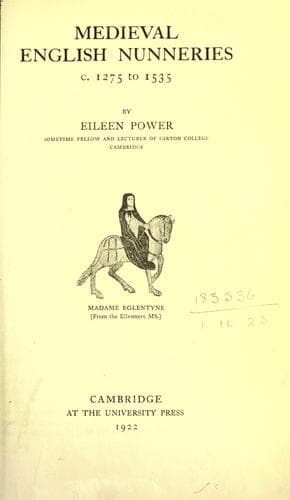
Medieval English Nunneries c. 1275 to 1535Power, Eileen
History
Medieval English Nunneries c. 1275 to 1535
Power, Eileen
Convents -- England; Monastic and religious life of women -- History
To financial incompetence and to the employment of improvident methods of
raising money, the nuns occasionally added extravagance. The bishops
forbade them to wear gay clothes for reasons unconnected with finance;
nevertheless their silks and furs must have cost money which could ill be
spared, and it is amusing to notice that even at Studley, Rothwell and
Langley, which were among the smallest and poorest houses in the diocese
of Lincoln and in debt, the nuns had to confess to silken veils. The
maintenance of a greater number of servants than the revenues of the house
could support was another not uncommon form of extravagance[693].
Instances of luxurious living on the part of the heads of various houses
have been given elsewhere[694]; it need only be remarked that a
self-indulgent prioress might cripple the resources of a house for many
years to come, whether by spending its revenues too lavishly, or by
raising money by the alienation of its goods.
One other cause of the poverty of nunneries must be noticed, before
turning to the attempts of bishops and other visitors to find a remedy.
Overcrowding was, throughout the earlier period under consideration, a
common cause of financial distress; and the admission of a greater number
of nuns than the revenues of the convent were able to support was
constantly forbidden in episcopal injunctions. Certainly this was not
invariably the fault of the nuns. They suffered (as we have seen) from the
formal right of bishop or of patron to place a nun in their house on
special occasions, and they suffered still more from the constant pressure
to which they were subjected by private persons, anxious to obtain
comfortable provision for daughters and nieces. It was sometimes
impossible and always difficult to resist the importunity of influential
gentlemen in the neighbourhood, whose ill-will might be a serious thing,
whether it showed itself in open violence or in closed purses. The
authorities of the church had sometimes to step in and rescue houses which
had thus been persuaded to burden themselves beyond their means. In 1273
Gregory X issued a bull to the Priory of Carrow, with the intention of
putting a stop to the practice.
Your petition having been expounded to us, containing a complaint that
you have, at the instant requests of certain lords of England, whom
you are unable to resist on account of their power, received so many
nuns already into your monastery, that you may scarce be fitly
sustained by its rents, we therefore, by the authority of these
present letters, forbid you henceforth to receive any nun or sister to
the burden of your house[695].
Some nine years later Archbishop Wickwane wrote in the same strain to the
nuns of Nunkeeling and Wilberfoss:
Public-domain text, read in full here on John Shaqi.
Reviews
Reviews
No reviews yet
Be the first to share your thoughts on this work.
Elsewhere in the archive
Join the Discussion
Join the discussion
Sign in to leave a comment or review.
Sign InorCreate an account