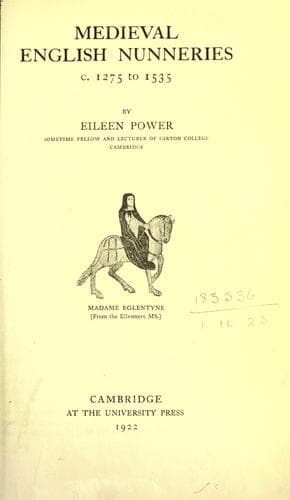
Medieval English Nunneries c. 1275 to 1535Power, Eileen
History
Medieval English Nunneries c. 1275 to 1535
Power, Eileen
Convents -- England; Monastic and religious life of women -- History
Because we have learned from public rumour that your monastery is
sometimes burdened by the reception of nuns and by the visits of
secular women and girls, at the instance of great persons, to whom you
foolishly and unlawfully grant easy permission, we order you ...
henceforward, to receive no one as nun or sister of your house, or to
lodge for a time in your monastery, without our special licence[696].
Bishop Stratford, in his visitation of Romsey in 1311, forbade additions
to the nuns, the proper number having been exceeded, and again in 1327 he
wrote:
It is notorious that your house is burdened with ladies beyond the
established number which used to be kept; and I have heard that you
are being pressed to receive more young ladies (_damoyseles_) as nuns,
wherefore I order you strictly that no young lady received by you be
veiled, nor any other received, until the Bishop's visitation, or
until they have special orders from him[697].
The situation at the great Abbey of Shaftesbury was the same. As early as
1218 the Pope had forbidden the community to admit nuns beyond the number
of a hundred because they were unable to support more or to give alms to
the poor; in 1322 Bishop Mortival wrote remonstrating with them for their
neglect of the Pope's order and repeating the prohibition to admit more
nuns until the state of the Abbey was relieved, on the ground that the
inmates of the house were far too many for its goods to support; and in
1326 (in response to a petition from the Abbess asking him to fix the
statutory number) the Bishop issued an order stating that the house was
capable of maintaining a hundred and twenty nuns and no more and that no
novices were to be received until the community was reduced to that
number[698].
Episcopal prohibitions to receive new inmates without special licence were
very common, especially in the late thirteenth and early fourteenth
centuries. Bishops realised that overcrowding only increased the growing
poverty of the nunneries. In the poor diocese of York, between 1250 and
1320, the nuns were over and over again forbidden to receive nuns, lay
sisters or lay brothers without the licence of the Archbishop. Injunctions
to this effect were issued to Marrick (1252), Swine (1268), Wilberfoss
(1282), Nunappleton (1282, 1290, 1346), Hampole (1267, 1308, 1312), Arden
(1306), Thicket (1309, 1314), Nunkeeling (1282, 1314), Nunburnholme
(1318), Esholt (1318), Arthington (1318) and Sinningthwaite (1319)[699].
At Swine, after the visitation by Archbishop Walter Giffard in 1267-8, it
was noted among the _comperta_
Public-domain text, read in full here on John Shaqi.
Reviews
Reviews
No reviews yet
Be the first to share your thoughts on this work.
Elsewhere in the archive
Join the Discussion
Join the discussion
Sign in to leave a comment or review.
Sign InorCreate an account