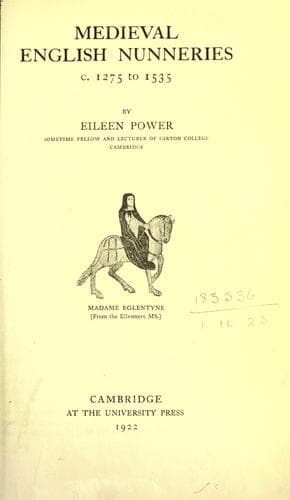
Medieval English Nunneries c. 1275 to 1535Power, Eileen
History
Medieval English Nunneries c. 1275 to 1535
Power, Eileen
Convents -- England; Monastic and religious life of women -- History
that the house of Swine cannot sustain more nuns or sisters than now
are there, inasmuch as those at present there are ill provided with
food, as is said above, and that the house nevertheless remains at
least a hundred and forty marks in debt; wherefore the lord Archbishop
decreed that no nun or sister should thenceforward be received there,
save with his consent[700].
A very severe punishment was decreed at Marrick, where the Archbishop
announced that any man or woman admitted without his licence would be
expelled without hope of mercy, the Prioress would be deposed and any
other nuns who agreed condemned to fast on bread and water for two months
(except on Sundays and festivals)[701]. In other dioceses the bishops
pursued a similar policy. But it was not easy to enforce these
prohibitions. Four years after Archbishop Greenfield's injunction to
Hampole (1308) he was obliged to address another letter to the convent,
having heard that the prioress had received
a little girl (_puellulam_), by name Maud de Dreffield, niece of the
Abbot of Roche, and another named Jonetta, her own niece, at the
instance of Sir Hugh de Cressy, her brother, that after a time they
might be admitted to the habit and profession of nuns[702].
The predicament of the Prioress is easily understood; how was she to
refuse her noble brother and the Abbot of Roche? They could bring to bear
far more pressure than a distant archbishop, who came upon his visitations
at long intervals. Moreover the ever present need of ready money made the
resistance of nuns less determined than it might otherwise have been; for
a dowry in hand they were, as usual, willing to encumber themselves with a
new mouth to feed throughout long years to come.
Prohibitions from increasing the number of nuns become more rare in the
second half of the fourteenth and during the fifteenth century. Even when
the population recovered from the havoc wrought by the Black Death, the
numbers in the nunneries continued steadily to decline. Perhaps fashion
had veered, conscious that the golden days of monasticism were over; more
likely the growing poverty of the houses rendered them a less tempting
retreat. A need for restricting the number of nuns still continued,
because the decline in the revenues of the nunneries was swifter than the
decline in the number of the nuns. Thus in 1440-1 Alnwick included in his
injunctions to seven houses a prohibition to receive more nuns than could
competently be sustained by their revenues[703], and the evidence given at
his visitations shows the necessity for such a restriction. The injunction
to Heynings is particularly interesting:
Public-domain text, read in full here on John Shaqi.
Reviews
Reviews
No reviews yet
Be the first to share your thoughts on this work.
Elsewhere in the archive
Join the Discussion
Join the discussion
Sign in to leave a comment or review.
Sign InorCreate an account