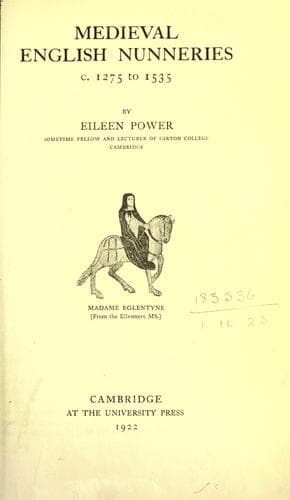
Medieval English Nunneries c. 1275 to 1535Power, Eileen
History
Medieval English Nunneries c. 1275 to 1535
Power, Eileen
Convents -- England; Monastic and religious life of women -- History
For as mykelle as we fonde that agayn the entente and the forbedyng of
the commune lawe there are in your saide pryorye meo nunnes and
susters professed then may be competently susteyned of the revenews of
your sayde pryorye, the exilitee of the saide revenews and charitees
duly considered, we commaunde, ordeyn, charge and enioyne yowe vnder
payne etc. etc. that fro this day forthe ye receyve no mo in to nunnes
ne sustres in your saide pryory wyth owte the advyse and assent of hus
(and) of our successours bysshope of Lincolne, so that we or thai,
wele informed of the yerely valwe of your saide revenews may ordeyn
for the nombre competente of nunnes and susters[704].
Nevertheless even at Nuncoton, one of the houses to which a similar
injunction was sent, a nun gave evidence "that in her oun time there were
in the habit eighteen or twenty nuns and now there are only fourteen," and
the Bishop himself remarked that "ther be but fewe in couent in regarde of
tymes here to fore"[705]. Everywhere this decline in the number of nuns
went steadily on during the fourteenth and fifteenth centuries[706]. And
from the beginning of the fifteenth century there appear, here and there
among visitatorial injunctions, commands of a very different nature; here
and there a Bishop is found trying, not to keep down, but to keep up the
number of nuns. Instead of the repeated prohibitions addressed to Romsey
at the beginning of the fourteenth century, there is an injunction from
William of Wykeham in 1387, ordering the Abbess to augment the number of
nuns, which had fallen far below the statutory number[707]. Similarly in
1432 Bishop Gray wrote to Elstow,
since the accustomed number of nuns of the said monastery has so
lessened, that those who are now received scarcely suffice for the
chanting of divine service by night and day according to the
requirement of the rule, we will and enjoin upon you the abbess, in
virtue of obedience and under the penalties written above and beneath,
that, with what speed you can, you cause the number of nuns in the
said monastery to be increased in proportion to its resources[708].
At Studley in 1531, although the house was badly in debt, the nuns were
ordered to live less luxuriously and "to augment your nombre of ladyes
within the yere"[709]. In this connection Archbishop Warham's visitation
of Sheppey in 1511 is significant. The Prioress, when questioned as to the
number of nuns in the house, said that "she had heard there were
seventeen; she knew of fourteen; she herself wished to increase the number
to fourteen if she could find any who wished to enter into religion"[710].
It is an interesting reflection that Henry VIII may simply have
accelerated, by his violent measure, a gradual dissolution of the
nunneries through poverty and through change of fashion.
Public-domain text, read in full here on John Shaqi.
Reviews
Reviews
No reviews yet
Be the first to share your thoughts on this work.
Elsewhere in the archive
Join the Discussion
Join the discussion
Sign in to leave a comment or review.
Sign InorCreate an account