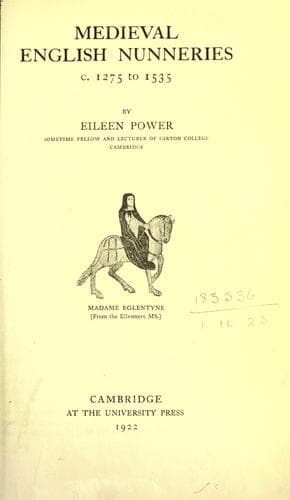
Medieval English Nunneries c. 1275 to 1535Power, Eileen
History
Medieval English Nunneries c. 1275 to 1535
Power, Eileen
Convents -- England; Monastic and religious life of women -- History
Trusting in your industry, we by tenour of the present (letters) give
you power during our pleasure to look after, guard and administer the
temporal possessions of our beloved religious ladies, the Prioress and
convent of Kirklees in our diocese, throughout their manors and
buildings (_loca_) wherever these be, and to receive and hear the
account of all servants and ministers serving in the same, and to make
those payments (_allocandum_) which by reason ought to be made, as
well as to remove all useless ministers and servants and to appoint in
their place others of greater utility, and to do all other things
which shall seem to you to be to the advantage of the place, firmly
enjoining the said prioress and convent, as well as the sisters and
lay brothers of the house, in virtue of holy obedience, that they
permit you freely to administer in all and each of the aforesaid
matters[792].
It must have been of great assistance to the worried and incompetent nuns
to have a reliable guardian thus to look after their temporal affairs, and
it is difficult to understand why the practice of having a resident prior
died out at the Cistercian houses and at Benedictine houses (e.g. St
Michael's, Stamford) which had such an official in the thirteenth and
early fourteenth centuries. Even the appointment of neighbouring rectors
as _custodes_ of nunneries in the York and Lincoln dioceses ceased,
apparently, to be common by the middle of the fourteenth century[793]. It
is a curious anomaly that this remedy should have been applied less and
less often during the very centuries when the nunneries were becoming
increasingly poor, and stood daily in greater need of external assistance
in the management of their temporal affairs.
CHAPTER VI
EDUCATION
Abstinence the abbesse myn a. b. c. me taughte.
_Piers Plowman._
The Benedictine ideal set study together with prayer and labour as the
three bases of monastic life and in the short golden age of English
monasticism women as well as men loved books and learning. The tale of the
Anglo-Saxon nuns who corresponded with St Boniface has often been told.
Eadburg, Abbess of Thanet, wrote the Epistles of St Peter for him in
letters of gold and sent books to him in the wilds of Germany. Bugga,
Abbess of a Kentish house, exchanged books with him. The charming Lioba,
educated by the nuns of Wimborne, sent him verses which she had composed
in Latin, which "divine art" the nun Eadburg had taught her, and begged
him to correct the rusticity of her style. Afterwards she came into
Germany to help him and became Abbess of Bischofsheim and her biographer
tells how
Public-domain text, read in full here on John Shaqi.
Reviews
Reviews
No reviews yet
Be the first to share your thoughts on this work.
Elsewhere in the archive
Join the Discussion
Join the discussion
Sign in to leave a comment or review.
Sign InorCreate an account