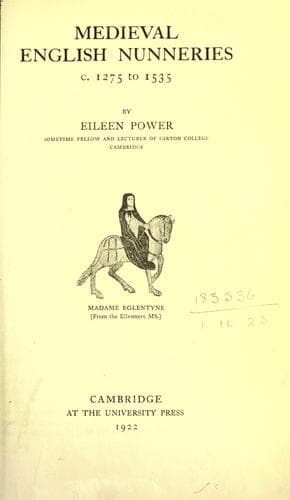
Medieval English Nunneries c. 1275 to 1535Power, Eileen
History
Medieval English Nunneries c. 1275 to 1535
Power, Eileen
Convents -- England; Monastic and religious life of women -- History
she was so bent on reading that she never laid aside her book except
to pray or to strengthen her slight frame with food and sleep. From
childhood upwards she had studied grammar and the other liberal arts,
and hoped by perseverance to attain a perfect knowledge of religion,
for she was well aware that the gifts of nature are doubled by study.
She zealously read the books of the Old and New Testaments and
committed their divine precepts to memory; but she further added to
the rich store of her knowledge by reading the writings of the holy
Fathers, the canonical decrees and the laws of the Church.
So also an anonymous Anglo-Saxon nun of Heidenheim wrote the lives of
Willibald and Wunebald[794].
The Anglo-Saxon period seems, however, to have been the only one during
which English nuns were at all conspicuous for learning. There is indeed
very scant material for writing their history between the Norman Conquest
and the last years of the thirteenth century, when Bishops' Registers
begin. It is never safe to argue from silence and some nuns may still
have busied themselves over books; but two facts are significant: we have
no trace of women occupying themselves with the copying and illumination
of manuscripts and no nunnery produced a chronicle. The chronicles are the
most notable contribution of the monastic houses to learning from the
eleventh to the fourteenth centuries; and some of the larger nunneries,
such as Romsey, Lacock, and Shaftesbury, received many visitors and must
have heard much that was worth recording, besides the humbler annals of
their own houses. But they recorded nothing. The whole trend of medieval
thought was against learned women and even in Benedictine nunneries, for
which a period of study was enjoined by the rule, it was evidently
considered altogether outside the scope of women to concern themselves
with writing. While the monks composed chronicles, the nuns embroidered
copes; and those who sought the gift of a manuscript from the monasteries,
sought only the gift of needlework from the nunneries.
Public-domain text, read in full here on John Shaqi.
Reviews
Reviews
No reviews yet
Be the first to share your thoughts on this work.
Elsewhere in the archive
Join the Discussion
Join the discussion
Sign in to leave a comment or review.
Sign InorCreate an account