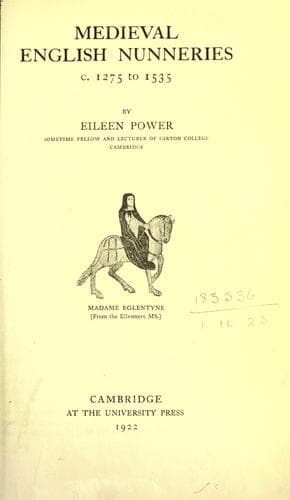
Medieval English Nunneries c. 1275 to 1535Power, Eileen
History
Medieval English Nunneries c. 1275 to 1535
Power, Eileen
Convents -- England; Monastic and religious life of women -- History
It is not, perhaps, surprising that the nuns should have written no
chronicles and copied few, if any, books. But it is surprising that
England should after the eighth century be able to show so little record
of gifted individuals. Even if the rule of a professedly learned order
were unlikely to prevail against the general trend of civilisation and to
produce learned women, still it might have been expected that here and
there a genius, or a woman of some talent for authorship, might have
flourished in that favourable soil; or even that a whole house might have
enjoyed for a brief halcyon period the zest for learning, when "alle was
buxomnesse there and bokes to rede and to lerne." In Germany, at various
periods of the middle ages, this did happen. The Abbey of Gandersheim in
Saxony was renowned for learning in the tenth century and here lived and
flourished the nun Roswitha, who not only wrote religious legends in Latin
verse, but even composed seven dramas in the style of Terence, a poem on
the Emperor Otto the Great and a history of her own nunnery. From the
internal evidence of her works it has been thought that this nun was
directly familiar with the works of Virgil, Lucan, Horace, Ovid, Terence
and perhaps Plautus, Prudentius, Sedulius, Fortunatus, Martianus Capella
and Boethius; but apart from this evidence of learning, her plays show
her to have been a woman of originality and some genius; they are strange
productions to have emanated from a tenth century convent[795]. It was in
Germany again, at Hohenburg in Alsace, that the Abbess Herrad in the
twelfth century compiled and decorated with exquisite illuminations the
great encyclopedia known as the _Hortus Deliciarum_. This book, one of the
finest manuscripts which had survived from the middle ages and a most
invaluable source of information for the manners and appearance of the
people of Herrad's day, was destroyed in the German bombardment of
Strasburg in 1870[796]. The same century saw the lives of the two great
nun-mystics, St Hildegard of Bingen and St Elisabeth of Schoenau, who saw
visions, dreamed dreams and wrote them down[797]. In the next century the
convent of Helfta in Saxony was the home of several literary nuns and
mystics and was distinguished for culture; its nuns collected books,
copied them, illuminated them, learned and wrote Latin, and three of them,
the beguine Mechthild, the nun Saint Mechthild von Hackeborn and the nun
Gertrud the Great, have won considerable fame by their mystic
writings[798]. Even in the decadent fifteenth century examples are not
wanting of German nuns who were keenly interested in learning; and in the
early sixteenth century Charitas Pirckheimer, nun of St Clare at Nuremberg
and sister of the humanist Wilibald Pirckheimer, was in close relations
with her brother and with many of his friends and full of enthusiasm for
the new learning[799].
Public-domain text, read in full here on John Shaqi.
Reviews
Reviews
No reviews yet
Be the first to share your thoughts on this work.
Elsewhere in the archive
Join the Discussion
Join the discussion
Sign in to leave a comment or review.
Sign InorCreate an account