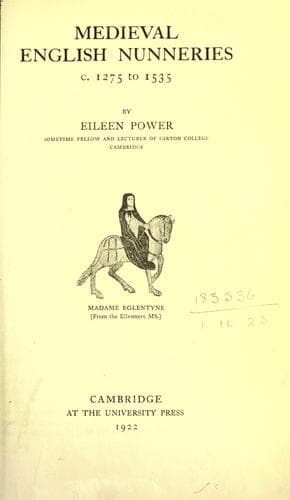
Medieval English Nunneries c. 1275 to 1535Power, Eileen
History
Medieval English Nunneries c. 1275 to 1535
Power, Eileen
Convents -- England; Monastic and religious life of women -- History
It is strange that in England there is no record of any house which can
compare with Gandersheim, Hohenburg or Helfta; no record of any nun to
compare with the learned women and great mystics who have been mentioned.
The air of the English nunneries would seem to have been unfavourable to
learning. The sole works ascribed to monastic authoresses are a _Life of
St Catherine_, written in Norman-French by Clemence, a nun of Barking, in
the late twelfth century[800], and _The Boke of St Albans_, a treatise on
hawking, hunting and coat armour, printed in 1486, by one Dame Juliana
Berners, whom a vague and unsubstantiated tradition declares to have been
Prioress of Sopwell. Nor do nuns seem to have been more active in copying
manuscripts. Several beautiful books, which have come down to our own day,
can be traced to nunneries, but there is no evidence that they were
written there and all other evidence makes it highly improbable that they
were. It is true that in 1335 we find this entry among the issues of the
Exchequer:
To Isabella de Lancaster, a nun of Amesbury, in money paid to her by
the hands of John de Gynewell for payment of 100 marks, which the lord
the King commanded to be paid her for a book of romance purchased from
her for the King's use, which remains in the chamber of the lord the
King, 66 l. 13 s. 4 d[801],
but it is unlikely that the book thus purchased by the King from his noble
kinswoman was her own work.
This period of the later ages was, indeed, unfavourable to learning among
monks as well as among nuns. As the universities grew, so the monasteries
declined in lustre; learning had no longer need to seek refuge behind
cloister walls, and the most promising monks now went to the universities,
instead of studying at home in their own houses. The standard of the
chronicles rapidly declined and the best chronicler of the fourteenth
century was not a monk like Matthew Paris, but a secular, a wanderer, a
hanger-on of princes, Froissart. As the fifteenth century passed learning
declined still further; and it is evident from the visitations of the time
that the monks, whatever else they might be, were not scholars. We should
expect the decline in learning to be more marked still among the nuns,
considering how little they had possessed in preceding centuries; and the
matter is worth some study, because it concerns not only the education of
the nuns themselves, but the education which they were qualified to give
to the children who were sent to school with them.
Public-domain text, read in full here on John Shaqi.
Reviews
Reviews
No reviews yet
Be the first to share your thoughts on this work.
Elsewhere in the archive
Join the Discussion
Join the discussion
Sign in to leave a comment or review.
Sign InorCreate an account