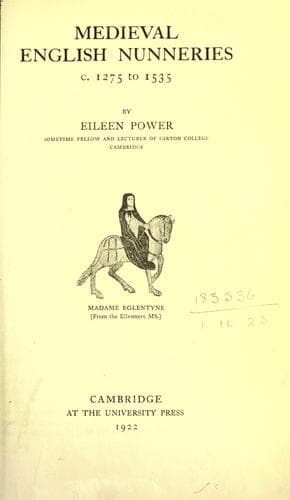
Medieval English Nunneries c. 1275 to 1535Power, Eileen
History
Medieval English Nunneries c. 1275 to 1535
Power, Eileen
Convents -- England; Monastic and religious life of women -- History
A word may first be said on the subject of nunnery libraries. Concerning
these we have very little information; and, such as it is, it does not
leave the impression that nunneries were rich in books. No catalogue of a
nunnery library[802] has come down to us and such references to libraries
as occur in inventories show great poverty in this respect, the books
being few and chiefly service-books. An inventory of the small and poor
convent of Easebourne, taken in 1450, shows what was doubtless quite a
large library for a house of its size. It contained two missals, two
_portiforia_ (breviaries), four antiphoners, one large _Legenda_, eight
psalters, one book of collects, one tropary, one French Bible, two
_ordinalia_ in French, one book of the Gospels and one martyrology[803].
The inventories of Henry VIII's commissioners give very little information
as to books and seem to have found few that were of any value. The books
found at Sheppey are thus described: "ij bokes with ij sylver clapses the
pece, and vj bokes with one sylver clasp a pec, l bokes good and bad" (in
the church), "vij bokes, whereof one goodly mase boke of parchement and
dyvers other good bokes" (in the vestry), and "an olde presse full of old
boks of no valew" (in a chapel in the churchyard) and "a boke of Saynts
lyfes" (in the parlour)[804]. At Kilburn were found "two books of _Legenda
Aurea_, one in print, the other written, both English, 4_d._"; the one in
print must have been Caxton's edition, thus valued, together with a
manuscript, at something like 6_s._ 8_d._ in present money for the pair!
Also "two mass books, one old written, the other in print, 20_d._, four
processions in parchment (3_s._) and paper (10_d._), two Legends in
parchment and paper, 8_d._, and two chests, with divers books pertaining
to the church, of no value"[805]. It will be noted that the books are
almost always connected with the church services. It is perhaps
significant that in only one list of the inmates of a house is a nun
specifically described as librarian[806].
Public-domain text, read in full here on John Shaqi.
Reviews
Reviews
No reviews yet
Be the first to share your thoughts on this work.
Elsewhere in the archive
Join the Discussion
Join the discussion
Sign in to leave a comment or review.
Sign InorCreate an account