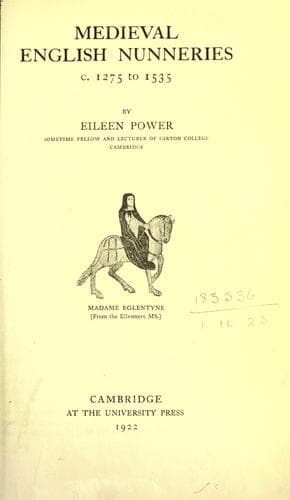
Medieval English Nunneries c. 1275 to 1535Power, Eileen
History
Medieval English Nunneries c. 1275 to 1535
Power, Eileen
Convents -- England; Monastic and religious life of women -- History
Something may be gleaned also from the legacies of books left to nuns in
medieval wills. These again are nearly always psalters or service books of
one kind or another; and indeed the average layman was more likely to
possess these than other books, for all alike attended the services of the
church. Thus Sir Robert de Roos in 1392 leaves his daughter, a nun, "a
little psalter, that was her mother's"[807]; Sir William de Thorp in 1391
leaves his sister-in-law, a nun of Greenfield, a psalter[808]; William
Stow of Ripon in 1430 leaves the Prioress of Nunmonkton a small
psalter[809], William Overton of Helmsley in 1481 leaves his niece Elena,
a nun of Arden, "one great Primer with a cover of red damask"[810], and so
on. There may be some significance in the fact that John Burn, chaplain at
York Cathedral, leaves the Prioress and Convent of Nunmonkton "an English
book of Pater Noster"[811]. It strikes a strange and pleasant note when
Thomas Reymound in 1418 leaves the Prioress and Convent of Polsloe 20_s._
and the _Liber Gestorum Karoli, Regis Francie_[812], and when Eleanor Roos
of York in 1438 leaves Dame Joan Courtenay "unum librum vocatum
Mauldebuke," whatever that mysterious tome may have contained[813].
Some light is also thrown backward upon their possessors by isolated books
which have come down to our own day and are known to have belonged to
nuns. These come mostly, as might be expected, from the great abbeys of
the south, where the nuns were rich and of good birth, from Syon and
Barking, Amesbury, Wilton and Shaftesbury, St Mary's Winchester, and
Wherwell[814]. Sometimes the MS. records the name of the nun owner. Wright
and Halliwell quote from a Latin breviary, in which is an inscription to
the effect that it belonged to Alice Champnys, nun of Shaftesbury, who
bought it for the sum of 10_s._ from Sir Richard Marshall, rector of the
parish church of St Rumbold of Shaftesbury. There follows this prayer for
the use of the nun:
Trium puerorum cantemus himnum quem cantabant in camino ignis
benedicentes dominum. O swete Jhesu, the sonne of God, the endles
swetnesse of hevyn and of erthe and of all the worlde, be in my herte,
in my mynde, in my wytt, in my wylle, now and ever more, Amen. Jhesu
mercy, Jhesu gramercy, Jhesu for thy mercy, Jhesu as I trust to thy
mercy, Jhesu as thow art fulle of mercy, Jhesu have mercy on me and
alle mankynde redemyd with thy precyouse blode. Jhesu, Amen[815].
A manuscript of Capgrave's _Life of St Katharine of Alexandria_, which
belonged to Katherine Babyngton, subprioress of Campsey in Suffolk, has a
very different inscription:
Iste liber est ex dono Kateryne Babyngton quondam subpriorisse de
Campseye et si quis illum alienauerit sine licencia vna cum consensu
dictarum [sanctimonialium] conuentus, malediccionem dei omnipotentis
incurrat et anathema sit[816].
Public-domain text, read in full here on John Shaqi.
Reviews
Reviews
No reviews yet
Be the first to share your thoughts on this work.
Elsewhere in the archive
Join the Discussion
Join the discussion
Sign in to leave a comment or review.
Sign InorCreate an account