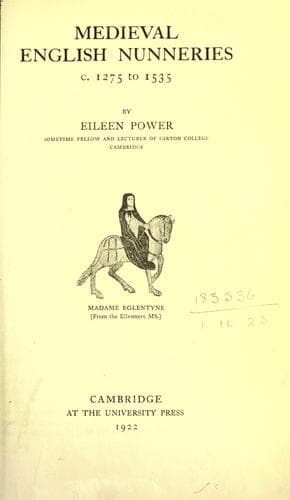
Medieval English Nunneries c. 1275 to 1535Power, Eileen
History
Medieval English Nunneries c. 1275 to 1535
Power, Eileen
Convents -- England; Monastic and religious life of women -- History
Sometimes the owner of a manuscript is known to us from other sources.
There is a splendid psalter, now in St John's College, Cambridge, which
belonged to the saintly Euphemia, Abbess of Wherwell from 1226 to 1257,
whose good deeds were celebrated in the chartulary of the house[817]. In
the Hunterian Library at Glasgow there is a copy of the first English
translation of Thomas a Kempis's _Imitatio Christi_, which belonged to
Elizabeth Gibbs, Abbess of Syon from 1497 to 1518; it is inscribed
O vos omnes sorores et ffratres presentes et futuri, orate queso pro
venerabili matre nostra Elizabeth Gibbis, huius almi Monasterii
Abbessa [_sic_], necnon pro deuoto ac religioso viro Dompno Willielmo
Darker, in artibus Magistro de domo Bethleem prope sheen ordinis
Cartuciensis, qui pro eadem domina Abbessa hunc librum conscripsit;
the date 1502 is given[818].
The books known to have been in the possession of nuns throw, as will be
seen, but a dim light upon the educational attainments of their owners.
More specific evidence must be sought in bishops' registers, and in such
references to the state of learning in nunneries as occur in the works of
contemporary writers. It is clear that nuns were expected to be
"literate"; bishops sending new inmates to convents occasionally assure
their prospective heads that the girls are able to undertake the duties of
their new state[819]. What to be sufficiently lettered meant, from the
convent point of view, appears in injunctions sent to the
Premonstratensian house of Irford, forbidding the reception of any nun
"save after such fashion as they are received at Irford and Brodholme, to
wit that they be able to read and to sing, as is contained in the statute
of the order"[820]; and again in injunctions sent by Bishop Gray to Elstow
about 1432:
We enjoin and charge you the abbess and who so shall succeed you ...
that henceforward you admit no one to be a nun of the said monastery
... unless she be taught in song and reading and the other things
requisite herein, or probably may be easily instructed within a short
time[821].
Public-domain text, read in full here on John Shaqi.
Reviews
Reviews
No reviews yet
Be the first to share your thoughts on this work.
Elsewhere in the archive
Join the Discussion
Join the discussion
Sign in to leave a comment or review.
Sign InorCreate an account