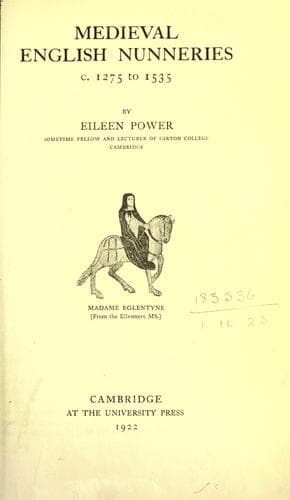
Medieval English Nunneries c. 1275 to 1535Power, Eileen
History
Medieval English Nunneries c. 1275 to 1535
Power, Eileen
Convents -- England; Monastic and religious life of women -- History
Further light is thrown on the question by an episode in the life of
Thomas de la Mare, Abbot of St Albans from 1349 to 1396. At that time the
subordinate nunnery of St Mary de Pre consisted of two grades of inmates,
nuns and sisters, who were never on good terms. The Abbot accordingly
transformed the sisters into nuns and ordained that no more sisters should
be received, but only "literate nuns." But hitherto the nuns also had been
illiterate; "they said no service, but in the place of the Hours they said
certain Lord's Prayers and Angelic Salutations." The Abbot therefore
ordered that they should be taught the service and that in future they
should observe the canonical hours, saying them without chanting, but
singing the offices for the dead at certain times. Since they had
apparently no books, from which to read the services, he gave them six or
seven ordinals, belonging to the Abbey of St Albans, which caused not a
little annoyance among the monks. In order that nuns should not be rashly
and easily admitted, he ordered that henceforth all who entered the house
were to profess the rule of St Benedict in writing[822].
The requirements seem to be that the nun should be able to take part in
the daily offices in the quire, for which reading and singing were
essential. It was not, it should be noted, essential to write, though
Abbot Thomas de la Mare required the nuns of St Mary de Pre to profess the
rule in writing and about 1330 the nuns of Sopwell (another dependency of
St Albans) were enjoined by the commissary of a previous Abbot to give
their votes for a new Prioress in writing[823]. Nevertheless, strange as
this may appear to many who are wont to credit the nuns with teaching
reading, writing, arithmetic and a number of other accomplishments to
their pupils, it is probable that some of the nuns of the fourteenth and
fifteenth centuries were unable to write. The form of profession of three
novices at Rusper in 1484 has survived and ends with the note "Et quelibet
earum fecit tale signum crucis manu sua propria [Maltese cross]"[824]
which might possibly imply that these nuns could not write their names. It
is significant that the official business of convents, their annual
accounts and any certificates which they might have to draw up, were done
by professional clerks, or sometimes by their chaplains. Payment to the
clerk who made the account occurs regularly in their account rolls; and
the Visitations of Bishop Alnwick, to which reference will be made below,
show that they were often completely at a loss, when writing had to be
done and there was no clerk to do it.
Public-domain text, read in full here on John Shaqi.
Reviews
Reviews
No reviews yet
Be the first to share your thoughts on this work.
Elsewhere in the archive
Join the Discussion
Join the discussion
Sign in to leave a comment or review.
Sign InorCreate an account