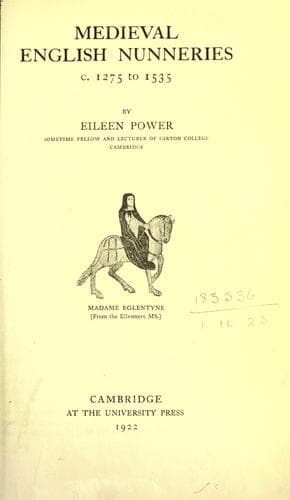
Medieval English Nunneries c. 1275 to 1535Power, Eileen
History
Medieval English Nunneries c. 1275 to 1535
Power, Eileen
Convents -- England; Monastic and religious life of women -- History
Monkes and als all leryd men
In Latin may it lyghtly ken,
And wytt tharby how they sall wyrk
To sarue god and haly kyrk.
Bott tyll women to mak it couth,
That leris no latyn in thar youth,
In inglis is it ordand here,
So that thay may it lyghtly lere[849].
About a century later, in 1517, Richard Fox, the Bishop of Winchester,
published for the benefit of the nuns of his diocese another English
translation of the Rule of St Benedict. In the preface he rehearses how
nuns are professed under the Rule and are bound to read, learn and
understand it:
and also after their profession they should not onely in them selfe
kepe observe execute and practise the said rule but also teche other
and heir sisters the same, and so moche that for the same intent they
daily rede and cause to be rede some parte of the sayd rule by one of
the sayd sisters amonges them selfe as well in their Chapiter House
after the redinge of the Martyrologe as some tyme in their Fraitur in
tyme of refections and collacions, at the which reding is always don
in the latin tonge, whereof they have no knowledge nor understandinge
but be utterly ignorant of the same, whereby they do not only lose
their tyme but also renne into the evident danger and perill of the
perdicion of their soules.
He adds that in order to save the souls of his nuns, and in particular to
ensure that novices understand the Rule before profession,
so that none of them shall nowe afterward probably say that she wyste
not what she professed, as we knowe by experience that some of them
have sayd in tyme passed, for these causes at thinstant requeste of
our ryght dere and well-beloved daughters in oure Lorde Jhesu, the
Abbasses of the Monasteries of Rumsay, Wharwel, Seynt Maries within
the Citie of Winchester and the Prioresses of Wintnay, our right
religious diocesans, we have translated the sayd rule unto our moders
tonge; comune, playne rounde Englishe, easy and redy to be understande
by the sayde devoute religiouse women[850].
The inconvenience of not being able to read the foundation charter and
other legal documents of the house, as confessed by the Prioress of
Langley at Alnwick's visitation, was very great; and about 1460 Alice
Henley, the Abbess of Godstow, caused a translation to be made of the
Latin register, in which were copied all the charters of her abbey. The
translator's preface to the work is interesting:
Public-domain text, read in full here on John Shaqi.
Reviews
Reviews
No reviews yet
Be the first to share your thoughts on this work.
Elsewhere in the archive
Join the Discussion
Join the discussion
Sign in to leave a comment or review.
Sign InorCreate an account