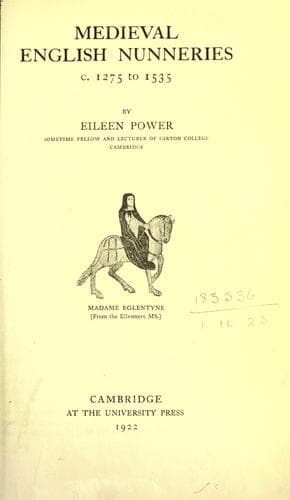
Medieval English Nunneries c. 1275 to 1535Power, Eileen
History
Medieval English Nunneries c. 1275 to 1535
Power, Eileen
Convents -- England; Monastic and religious life of women -- History
The wyseman tawht hys chyld gladly to rede bokys and hem well
vndurstonde for, in defaute of vndyrstondyng, is ofttymes caused
neclygence, hurte, harme and hynderaunce, as experyence prevyth in
many a place. And for as muche as women of relygyone in redynge bokys
of latyn, byn excusyd of grete vndurstandyng, where it is not her
modyr tonge; Therfore, how be hyt that they wolde rede her bokys of
remembraunce of her munymentys wryte in latyn, for defaute of
undurstondyng they toke ofte tymes grete hurt and hyndraunce; and,
what for defaute of trewe lernyd men that all tymes be not redy hem to
teche and counsayl, and feere also and drede to shewe her euydence
opynly (that oftyntyme hath causyd repentaunce). Hyt wer ryht
necessary, as hyt semyth to the undyrstondyng of suche relygyous
women, that they myght haue, out of her latyn bokys, sum wrytynge in
her modyr tonge, wher-by they might haue bettyr knowlyge of her
munymentys and more clerely yeue informacyon to her serauntys, rent
gedurarys, and receyuowrs, in the absent of her lernyd councell.
Wher-fore, a poore brodur and welwyller ... to the goode Abbas of
Godstowe, Dame Alice henley, and to all her couent, the whych byn for
the more party in Englyssh bokys well y-lernyd, hertyly desyryng the
worship, profyt and welfare of that deuoute place, that, for lak of
vndurstondyng her munymentys sholde in no damage of her lyflod
huraftur fallyn, In the worship of our lady and seynt John Baptist
patron of thys seyd monastery, the sentence for the more partyre of
her munymentys conteynd in the boke of her regystr in latyn, aftyr the
same forme and ordyr of the seyd boke, hath purposyd with goddys grace
to make, aftur hys conceyt, fro latyn into Englyssh, sentencyosly, as
foloweth thys symple translacion[851].
It will be noticed that the benevolent translator of this Godstow register
says that the nuns are for the most part well learned in English books.
The same impression is given by the translations which were made for the
nuns of Syon. The most famous of these is the _Myroure of Oure Ladye_,
written for the nuns by Thomas Gascoigne (1403-58) and first printed in
1530. This book contains a devotional treatise on divine service, with a
translation and explanation of the "Hours" and "Masses" of our Lady, as
they were used at Syon. The author explains his purpose thus:
Public-domain text, read in full here on John Shaqi.
Reviews
Reviews
No reviews yet
Be the first to share your thoughts on this work.
Elsewhere in the archive
Join the Discussion
Join the discussion
Sign in to leave a comment or review.
Sign InorCreate an account