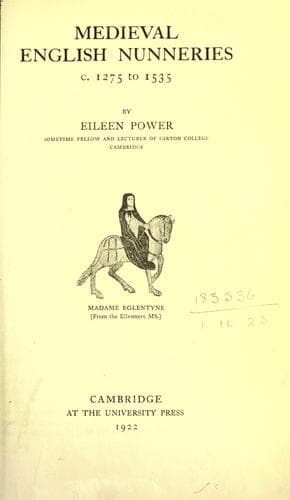
Medieval English Nunneries c. 1275 to 1535Power, Eileen
History
Medieval English Nunneries c. 1275 to 1535
Power, Eileen
Convents -- England; Monastic and religious life of women -- History
The house was evidently at this time a fashionable seminary for young
ladies. It must be remembered that it was a general custom among the
English nobility and gentry to send their children away to the household
of a lord, or person of good social standing, in order to learn breeding
and it was not uncommon to send boys to the household of an abbot. In 1450
Thomas Bromele, Abbot of Hyde, thus entertained in his house eight
"gentiles pueri," there were many "pueri generosi" at Westacre in 1494,
and Richard Whiting, the last Abbot of Glastonbury, is stated by Parsons
to have had, among his 300 servants, "multos nobilium filios"[882]. It was
doubtless much in the same way that the children of lords, knights and
gentlemen were put in the charge of the Abbess of St Mary's Winchester, a
great lady, who had her own "gentlewoman" to attend upon her and her own
private household. It is probable that the nuns taught these children, but
the boys who went as wards to abbeys seem often to have taken their tutors
with them, or at least to have been taught by special tutors. At
Lilleshall, for instance, the commissioners found four "gentylmens sons
and their scolemaster"[883] and it is significant that when little Gregory
Cromwell was sent to be brought up by Margaret Vernon, Prioress of Little
Marlow, he was taught by a private tutor and not by the nun.
Other references to the children received in nunneries confirms the
impression that they were of gentle birth. At Polesworth, as at St Mary's,
Winchester, the commissioners specified "gentylmens childern and
studiounts." At Thetford a daughter of John Jerves, _generosus_, is
mentioned in 1532 and two daughters of Laurens Knight, _gentleman_, were
at Cornworthy, c. 1470. The accounts of Sopwell in 1446 mention the
daughter of Lady Anne Norbery; at Littlemore in 1445 the daughter of John
FitzAleyn, steward of the house, and the daughter of Ingelram Warland are
boarders. Among the Carrow boarders, who may be set down as children, are
the son and two daughters of Sir Roger Wellisham, the daughter of Sir
Robert de Wachesam, a niece of William Bateman, Bishop of Norwich, and
girls with such well-known names as Fastolf, Clere, Baret, Blickling,
Shelton and Ferrers, though the last two may be adult boarders. The
Gracedieu boarders nearly all bear the names of neighbouring gentry and
one was the daughter of Lord Beaumont. In the course of time, as the urban
middle class grew and flourished, the daughters of the well-to-do
_bourgeoisie_ were sometimes sent to convents for their education. Thus
among the Carrow boarders we find a daughter of John de Erlham, a merchant
and citizen of Norwich, and Isabel Barber, daughter of Thomas Welan,
barber, who afterwards, however, became a nun. It is plain from the wills
which have been preserved that the wealthy Norwich burgesses were in the
habit of sending their daughters as nuns to Carrow, and it is a natural
Public-domain text, read in full here on John Shaqi.
Reviews
Reviews
No reviews yet
Be the first to share your thoughts on this work.
Elsewhere in the archive
Join the Discussion
Join the discussion
Sign in to leave a comment or review.
Sign InorCreate an account