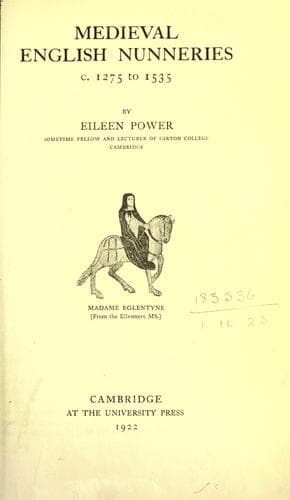
Medieval English Nunneries c. 1275 to 1535Power, Eileen
History
Medieval English Nunneries c. 1275 to 1535
Power, Eileen
Convents -- England; Monastic and religious life of women -- History
supposition that they should have sent them sometimes as schoolgirls; but
by birth and by wealth these city magnates were not far removed from the
neighbouring gentry. The school at Swaffham Bulbeck in 1483 was less
fashionable than that at Carrow and did not cater for the nobly born; it
was a small house and the names of the children suggest a sound middle
class establishment, perhaps the very one in which Chaucer's Miller's wife
of Trumpington was educated, full of the sons and daughters of the
burgesses of Cambridge, Richard Potecary of Cambridge, William Water,
Thomas Roch, unnamed fathers "of Cambridge," "of Chesterton," Parker "of
Walden," and "the merchant."
None of these examples can possibly be twisted into a case for the free,
or even the cheap, education of the poor. Just as we never find low-born
girls as nuns, so we never find them as schoolgirls and for the same
reason; "dowerless maidens," as Mr Leach says, "were not sought as nuns."
As will be seen hereafter, the reception of school children was
essentially a financial expedient; one of the many methods by which the
nuns sought to raise the wind[884]. The fees paid by these children are
recorded here and there, in nunnery accounts; education was apparently
thrown in with board, and the usual rate for board for children during the
century and a half before the Dissolution seems to have been about 6_d._ a
week, though the charge at Cornworthy c. 1470 was 10_d._ a week and at
Littlemore in 1445 only 4_d._ a week[885]. Occasionally the good nuns
suffered, like so many schoolmistresses since their day, from the
difficulty of extracting fees. Among the debts owing to the nuns of Esholt
at the Dissolution was one of 33_s._ from Walter Wood of Timble in the
parish of Otley for his child's board for a year and a half; and at
Thetford in 1532 the poor nuns complained that "John Jerves, gentleman,
has a daughter being nurtured in the priory and pays nothing." The most
melancholy case of all has been preserved to us owing to the fact that the
nuns, goaded to desperation, sought help from the Chancellor. About 1470
Thomasyn Dynham, Prioress of Cornworthy, made petition to the effect that
Laurens Knyghte, gentleman, had agreed with Margaret Wortham the late
Prioress, that she should take his two daughters "to teche them to scole,"
viz. Elizabeth, aged seven years, and "Jahne," aged ten years, at the
costs and charges of Laurens, who was to pay 20_d._ a week for them. So at
Cornworthy they remained during the life of Margaret, to the great costs
and charges and impoverishing of the said poor place, by the space of five
years and more, until the money due amounted to L21. 13_s._ 4_d._, "the
which sum is not contented ne paid, nor noo peny thereof." Laurense
meanwhile departed this life, leaving his wife "Jahne" executrix, and
Jahne, unnatural mother that she was, married again a certain John
Barnehous and utterly refused to pay for her unhappy daughters. One is
Public-domain text, read in full here on John Shaqi.
Reviews
Reviews
No reviews yet
Be the first to share your thoughts on this work.
Elsewhere in the archive
Join the Discussion
Join the discussion
Sign in to leave a comment or review.
Sign InorCreate an account