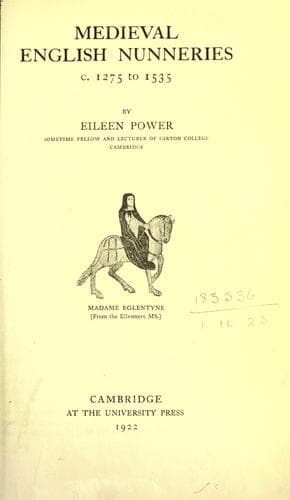
Medieval English Nunneries c. 1275 to 1535Power, Eileen
History
Medieval English Nunneries c. 1275 to 1535
Power, Eileen
Convents -- England; Monastic and religious life of women -- History
"No evidence whatever," says Mr Leach, "has been produced of what was
taught in nunneries. That ... something must have been taught, if only
to keep the children employed, is highly probable. That the teaching
included learning the Lord's Prayer, etc. by heart may be conceded.
Probably Fuller is right in guessing that it included reading; but it
is only a guess. One would guess that it included sewing and spinning.
As for its including Latin, no evidence is forthcoming and it is
difficult to see how those who did not know Latin could teach
it[896]."
Direct evidence is therefore absolutely lacking; all we can do is to
deduce probabilities from what we know of the education of the nuns
themselves, and it must be conceded that this was not always of a very
high order. It is quite certain, from the wording of some of the
visitation injunctions, that the quality and extent of the teaching must
have varied considerably from house to house. It was probably good (as the
education of women then went) at the larger and more fashionable houses,
mediocre at those which were small and struggling. Latin could not have
been taught, because, as has already been pointed out, the nuns at this
period did not know it themselves; but the children were probably taught
the _Credo_, the _Ave_ and the _Pater Noster_ in Latin by rote. They may
have been taught French of the school of Stratford atte Bowe, as long as
that language was fashionable in the outside world and known to the nuns,
but it died out of the convents after the end of the fourteenth century.
It seems pretty certain that the children must have been taught to read.
"Abstinence the abbesse myn a.b.c. me taughte," says Piers Plowman; the
Abbess of St Mary's Winchester buys the matins books for little Bridget
Plantagenet; and it will be remembered that the nuns of Godstow were said
about 1460 (fifteen years after Alnwick visited the house and gave
permission for children to be boarded there) to be "for the more party in
Englyssh bokys well y-lernyd." Caesarius of Heisterbach has a delightful
story, repeated thus in a fifteenth century _Alphabet of Tales_:
Caesarius tellis how that in Freseland in a nonrie ther was ii little
maydens that lernyd on the buke, and euer thai strafe whethur of thaim
shulde lern mor than the toder. So the tane of thaim happened to fall
seke and sho garte call the Priores vnto hur & sayd: "Gude ladie!
suffre nott my felow to lern vnto I cover of my sekenes, and I sall
pray my moder to gif me vj d & that I sall giff you & ye do so, ffor I
drede that whils I am seke, that sho sall pas me in lernyng, & that I
wolde not at sho did." And at this wurde the priores smylid & hadd
grete mervayle of the damysell conseyte[897].
Public-domain text, read in full here on John Shaqi.
Reviews
Reviews
No reviews yet
Be the first to share your thoughts on this work.
Elsewhere in the archive
Join the Discussion
Join the discussion
Sign in to leave a comment or review.
Sign InorCreate an account