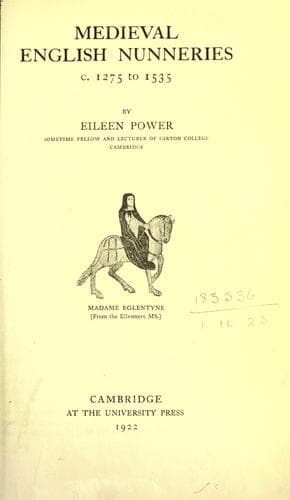
Medieval English Nunneries c. 1275 to 1535Power, Eileen
History
Medieval English Nunneries c. 1275 to 1535
Power, Eileen
Convents -- England; Monastic and religious life of women -- History
It is significant that Dame Juliana Berners is supposed by tradition
(unsupported, however, by any other evidence) to have been a prioress of
Sopwell. The gift of hunting rights to a nunnery is a common one; for
instance, Henry II granted to Wix the right of having two greyhounds and
four braches to take hares through the whole forest of Essex[961].
Doubtless these rights were usually exercised by proxy[962]; but
considering the popularity of hunting and hawking as sports for women, a
popularity so great that no lady's education was complete if she knew not
how to manage a hawk and bear herself courteously in the field, it is
surprising that there is not actual mention of these pastimes among nuns
as well as among monks.
Besides gay clothes and pets other frivolous amusements broke at times the
monotony of convent life. Dancing and mumming and minstrelsy were not
unknown and the nuns shared in the merrymaking on feasts sacred and
profane, as is witnessed by the account rolls of St Mary de Pre (1461-90),
with their list of payments for wassail at New Year and Twelfth Night, for
May games, for bread and ale on bonfire nights and for harpers and players
at Christmas[963]. In 1435 the nuns of Lymbrook were forbidden "all maner
of mynstrelseys, enterludes, daunsyng or reuelyng with in your sayde holy
place"[964], and about the same time Dean Kentwode wrote to St Helen's
Bishopsgate: "Also we enioyne you that all daunsyng and reuelyng be
utterly forborne among yow, except Christmasse and other honest tymys of
recreacyone among yowre self usyd in absence of seculars in all
wyse"[965]. The condemnation of dancing in nunneries is not surprising,
for the attitude of medieval moralists generally to this pastime is summed
up in Etienne de Bourbon's aphorism, "The Devil is the inventor and
governor and disposer of dances and dancers"[966]. Minstrels were
similarly under the ban of the church, and clerks were forbidden by canon
law and by numerous papal, conciliar and episcopal injunctions to listen
to their "ignominious art"[967], a regulation which, needless to say, went
unobeyed in an age when many a bishop had his private _histrio_[968], and
when the same stern reformer Grosseteste, who warned his clergy "ne mimis,
ioculatoribus aut histrionibus intendant," loved so much to hear the harp
that he kept his harper's chamber "next hys chaumbre besyde hys
stody"[969]. Langland asserts that churchmen and laymen alike spent on
minstrels money with which they well might have succoured the poor:
Clerkus and knyghtes . welcometh kynges mynstrales,
And for loue of here lordes . lithen hem at festes;
Muche more, me thenketh . riche men auhte
Haue beggars by-fore hem . which beth godes mynstrales[970].
Public-domain text, read in full here on John Shaqi.
Reviews
Reviews
No reviews yet
Be the first to share your thoughts on this work.
Elsewhere in the archive
Join the Discussion
Join the discussion
Sign in to leave a comment or review.
Sign InorCreate an account