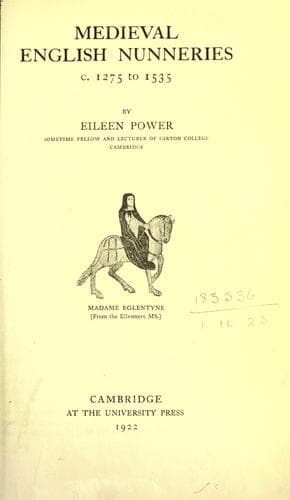
Medieval English Nunneries c. 1275 to 1535Power, Eileen
History
Medieval English Nunneries c. 1275 to 1535
Power, Eileen
Convents -- England; Monastic and religious life of women -- History
Even in monasteries they found a ready welcome[971] and the reforming
council of Oxford passed an ineffectual decree forbidding their
performances to be seen or heard or allowed before the abbot or monks, if
they came to a house for alms[972]. Indeed there was sometimes need for
care. Where but at one of those minstrelsies or interludes forbidden at
Lymbrook did sister Agnes of St Michael's Priory, Stamford, meet a
jongleur, who sang softly in her ear that Lenten was come with love to
town? The Devil (alas) had all the good tunes, even in the fifteenth
century. "One Agnes, a nun of that place," reported the Prioress, "has
gone away into apostasy cleaving to a harp-player, and they dwell
together, as it is said, in Newcastle-on-Tyne"[973]. For her no longer the
strait discipline of her rule, the black-robed nuns and heaven at the
end. For her the life of the roads, the sore foot and the light heart; for
her the company of ribalds with their wenches, and all the thriftless,
shiftless player-folk; for her, at the last, hell, with "the gold and the
silver and the vair and the gray, ... harpers and minstrels and kings of
the world"[974], or a desperate hope that the Virgin's notorious kindness
for minstrels might snatch her soul from perdition[975].
But the merrymakers in nunneries were not necessarily strange jongleurs or
secular folk. The dancing and revelry, which were forbidden at Lymbrook
and allowed in Christmastime at St Helen's, were probably connected with
the children's feast of St Nicholas. As early as the twelfth century the
days immediately before and after Christmas had become, in ecclesiastical
circles, the occasion for uproarious festivities[976]. The three days
after Christmas were appropriated by the three orders of the Church. On St
Stephen's Day (Dec. 26) the deacons performed the service, elected their
Abbot of Fools and paraded the streets, levying contributions from the
householders and passers-by; on St John the Evangelist's Day (Dec. 27) the
deacons gave way to the priests, who "gave a mock blessing and proclaimed
a ribald form of indulgence"; and on Innocents' Day it was the turn of the
choir or schoolboys to hold their feast. In cathedral and monastic
churches the Boy Bishop (who had been elected on December 5th, the Eve of
St Nicholas, patron saint of schoolboys) attended service on the eve of
Innocents' Day, and at the words of the Magnificat "He hath put down the
mighty from their seat" changed places with the Bishop or Dean or Abbot,
and similarly the canons and other dignitaries of the church changed
places with the boys. On Innocents' Day all services, except the essential
portions of the mass, were performed by the Boy Bishop; he and his staff
processed through the streets, levying large contributions of food and
money and for about a fortnight his rule continued, accompanied by
feasting and merrymaking, plays, disguisings and dances. These Childermas
Public-domain text, read in full here on John Shaqi.
Reviews
Reviews
No reviews yet
Be the first to share your thoughts on this work.
Elsewhere in the archive
Join the Discussion
Join the discussion
Sign in to leave a comment or review.
Sign InorCreate an account