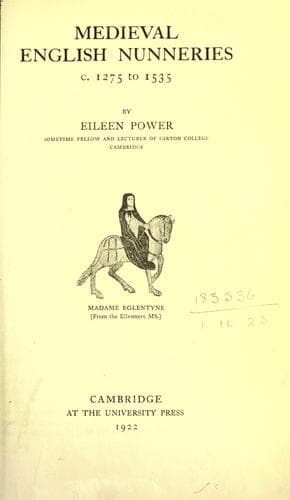
Medieval English Nunneries c. 1275 to 1535Power, Eileen
History
Medieval English Nunneries c. 1275 to 1535
Power, Eileen
Convents -- England; Monastic and religious life of women -- History
festivities took place in monastic as well as in secular churches, but
they seem to have been more common in nunneries than in male communities.
Our chief information about the revelries comes from Archbishop Eudes
Rigaud's province of Rouen[977]; but English records also contain
scattered references to the custom. Evidently a Girl Abbess or Abbess of
Fools was elected from among the novices, and at the _Deposuit_ she and
her fellow novices, or the little schoolgirls, took the place of the
Abbess and nuns, just as the Boy Bishop held sway in cathedral churches,
and feasting, dancing and disguising brought a welcome diversion into the
lives of both nuns and children. Even the strict Peckham was obliged to
extend a grudging consent to the _puerilia solemnia_ held on Innocents'
Day at Barking and at Godstow (1279), insisting only that they should not
be continued during the whole octave of Childermas-tide and should be
conducted with decency and in private:
The celebration of the Feast of Innocents by children, which we do not
approve, but rather suffer with disapproval, is on no account to be
undertaken by those children, nor are they to take any part in it,
until after the end of the vespers of St John the Evangelist's Day;
and the nuns are not to retire from the office, but having excluded
from the choir all men and women ... they are themselves to supply the
absence of the little ones lest (which God forbid) the divine praise
should become a mockery[978].
A more specific reference still is found at Carrow in 1526; Dame Joan
Botulphe deposed at a visitation that it was customary at Christmas for
the youngest nun to hold sway for the day as abbess and on that day (added
the soured ancient) was consumed and dissipated everything that the house
had acquired by alms or by the gift of friends[979]. The connection
between these revels and the Feast of Fools appears clearly in the
injunction sent by Bishop Longland to Nuncoton about the same time:
We chardge you, lady priores, that ye suffre nomore hereafter eny
lorde of mysrule to be within your house, nouther to suffre hereafter
eny suche disgysinge as in tymes past haue bene used in your monastery
in nunnes apparell ne otherwise[980].
The admission of seculars dressed up as nuns, and of boys dressed up as
women, the performance of interludes and the wild dancing were reason
enough for the distaste with which ecclesiastical authorities regarded
these festivities. For the nuns clearly did not exclude strangers as
Peckham had bidden. Indeed it seems probable that where they did not elect
a Girl Abbess, they admitted a Boy Bishop, either from some neighbouring
church, or just possibly one of their own little schoolboys. Among the
accounts of St Swithun's monastery at Winchester for 1441 there is a
payment
Public-domain text, read in full here on John Shaqi.
Reviews
Reviews
No reviews yet
Be the first to share your thoughts on this work.
Elsewhere in the archive
Join the Discussion
Join the discussion
Sign in to leave a comment or review.
Sign InorCreate an account