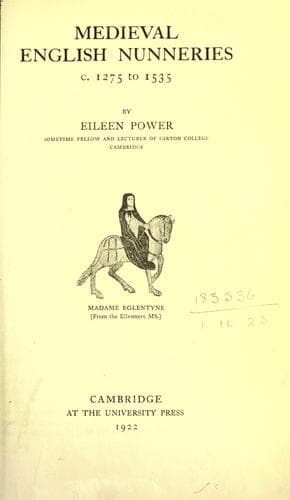
Medieval English Nunneries c. 1275 to 1535Power, Eileen
History
Medieval English Nunneries c. 1275 to 1535
Power, Eileen
Convents -- England; Monastic and religious life of women -- History
From whatever source nuns obtained control of money and goods, whether
from the _peculium_, from gifts, from legacies, or from the proceeds of
their own labour, one thing is clear: in a fourteenth or fifteenth century
house, where the system of the _peculium_ and the _familia_ obtained,
there was a considerable approximation to private life and to private
property. The control of money and goods and the division into households,
catering separately for themselves, worked in together. The responsibility
of the convent towards its members was sometimes limited to a bare minimum
of food, such as the staple bread and beer, and perhaps a small dress
allowance. All the rest was provided by the nuns themselves. In strict
theory annuities, gifts and legacies, were put into common stock and
administered by the convent. In practice they were obviously retained in
individual possession and administered as private property by the nuns.
Even legacies of lump sums to a whole convent were probably divided up
between the nuns, an equal sum being paid to each and perhaps double to
the prioress.
An analysis of the conditions revealed at Alnwick's visitation of the
Lincoln diocese in 1440-5 throws an exceedingly interesting side-light,
not only on the vow of monastic poverty, as understood in the fifteenth
century, but also on the domestic economy of the houses, the majority of
which were small and poor. It may also conveniently be compared with the
evidence given by the same visitations as to the system of _familiae_ in
these houses. At some the house supplied all food and clothes or a
_peculium_ for clothes, at some it provided only a bare minimum of food,
at some neither dress nor dress allowance was provided. At Legbourne
every nun has one loaf, one half gallon of beer a day, one pig a year,
18_d._ for beef, every day in Advent and Lent two herrings, and a
little butter in summer and sometimes two stone of cheese a year and
8_d._ a year for raiment and no more;
the sum of 2_s._ 2_d._ a year for beef and clothes was certainly not
excessive[1038]. At Stixwould
every nun receives in the year one pig, one sheep, a quarter of beef,
two stones of butter, three stones of cheese, every day in Advent and
Lent three herrings, six salt fish and twelve doughcakes a year; and
they were wont to have 6_s._ 8_d._ for their raiment, but for several
years back (one nun said for twenty years) as regards raiment they
have received nothing.
Public-domain text, read in full here on John Shaqi.
Reviews
Reviews
No reviews yet
Be the first to share your thoughts on this work.
Elsewhere in the archive
Join the Discussion
Join the discussion
Sign in to leave a comment or review.
Sign InorCreate an account