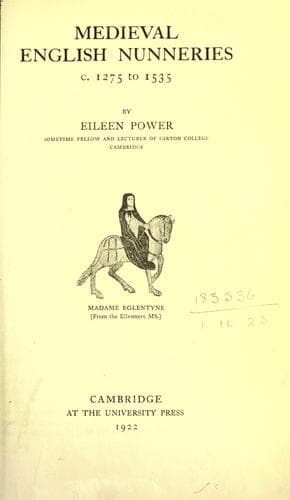
Medieval English Nunneries c. 1275 to 1535Power, Eileen
History
Medieval English Nunneries c. 1275 to 1535
Power, Eileen
Convents -- England; Monastic and religious life of women -- History
At St Michael's Stamford, the house provided only "bread and beer and a
mark for fish and flesh and other things and as to their raiment they
receive naught of the house"; out of the mark the nuns catered for
themselves. Other houses provided still less out of the common funds; at
Gokewell the nuns received nothing from the house but bread and beer and
at Markyate (a poor house, of not unblemished reputation and badly in
debt) "they receive of the house only bread, beer and two marks for their
raiment and what else is necessary for their living, which are less than
enough for their sundry needful wants"; Alnwick ordered all victuals to be
given them "of the commune stores of the house owte of one selare and one
kytchyne" and fixed the dress allowance at a noble yearly, but he did not
say how the house was to raise funds. At Nuncoton the allowance was 8_s._
a year, but when Alnwick came the nuns had received only 1_s._ each. At
Fosse, Langley and Ankerwyke the houses provided meat and drink, but no
dress or dress allowance; and at Catesby it was complained that "the
prioress does not give the nuns satisfaction in the matter of their
raiment and money for victuals and touching the premises the prioress is
in the nuns' debt for three-quarters of the year"[1039]. From these
references it is plain that the nuns usually bought their own clothes and
often catered for themselves in flesh food; also that the poverty of many
houses was so great that the nuns could not have lived decently without
the help of friends, whether because their dress allowances were always in
arrears, or because the house recognised no responsibility to clothe them
from its exiguous funds. Yet as regards food at least, the habit of
catering separately for separate messes was undoubtedly less economical
than the regular maintenance of a common table would have been.
A highly interesting light on the control of money allowances for the
purchase of food by the individual nuns of a convent is thrown by convent
account rolls. These accounts show two different methods of catering in
force. In one all the housekeeping was done by the cellaress, who bought
such stores as were needed to supplement the produce of the home farm and
provided the nuns with the whole of their food. This is the normal method,
which accords with the Rule; it is to be found in the Syon cellaresses'
rolls and in the roll of Elizabeth Swynford, Prioress of Catesby
(1414-15). The latter sets forth: (1) the produce of the home farm, how
many animals were delivered to the larder, how many to the kitchen, how
much grain was malted, etc.; (2) the payments for food bought to
supplement this home produce:
in flesh and eggs bought from the feast of St Michael until Lent
33/0-1/2, and in expenses of the house from Easter unto the feast of
St Michael in beef and eggs bought, L7. 1. 9., ... in 2 barrels 4
kemps of oil and salt fish bought in time of Lent L3. 0. 6,
Public-domain text, read in full here on John Shaqi.
Reviews
Reviews
No reviews yet
Be the first to share your thoughts on this work.
Elsewhere in the archive
Join the Discussion
Join the discussion
Sign in to leave a comment or review.
Sign InorCreate an account