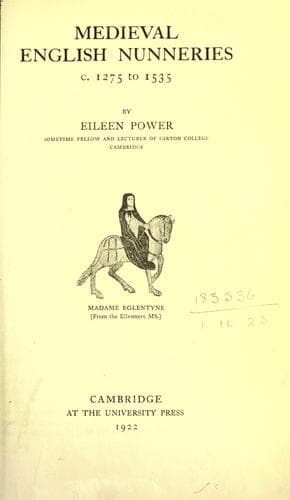
Medieval English Nunneries c. 1275 to 1535Power, Eileen
History
Medieval English Nunneries c. 1275 to 1535
Power, Eileen
Convents -- England; Monastic and religious life of women -- History
besides sundry odd purchases of red herrings, pepper, saffron, salt,
garlic and fat[1040].
But some account rolls show an entirely different method of housekeeping.
By this the convent provided the nuns with their daily ration of bread and
beer and perhaps with a certain amount of green food and dairy produce,
but paid them an allowance of money with which to buy their meat and fish
food for themselves. On this system the convent still had to provide the
nuns with their pittances, though often enough these too were paid in
money, and usually also with the bulk of their Lenten fare of salt fish
and spices, which was bought in large quantities at a time and stored. An
extreme example of this system is found in the account of Christian
Bassett, Prioress of St Mary de Pre (St Albans) in 1486-8. Under the
heading _Comyns, Pytances and Partycions_ she pays to herself as prioress:
for her comyns for xxj monethes ... vj l. viij s iiij d. ... Item paid
to dame Alice Wafyr for her comyns for xxj monethes ... vj l. viij s
iiij d. ... Item paid to vij susters of the same place for their
comons for xxj monethis ... xxj li. vj s viij d. Item paid to dame
Johan Knollys for her comyns for v monethis xvj s viij d. ... Item
paid for brede and ale and fewell departyd amongs the susters by a
yere and a half lij s. Item paid for ij bushell of pesyn departyd
amongs the susters in Lente xvj d.
The rest of the section contains notices of special pittances, paid
sometimes in money and sometimes in kind; for instance 10_s._ 6_d._ is
paid for "Maundy Ale" and 10_d._ for wine on two Maundy Thursdays, but the
sisters also get "Maundy money" amounting to 21_d._ One interesting item
runs: "delyvered of the rente in Cambrigge amongs the susters for the tyme
of this accompte xlviij s"; these rents, which are entered among the
receipts, were no doubt ear-marked for the nuns, possibly as _peculia_ for
the purchase of clothes, possibly as a pittance[1041]. The same system of
housekeeping was obviously also in vogue at St Michael's, Stamford, at the
time of Alnwick's visitation; but the account rolls of this house are not
easy to interpret, because although they contain no reference to catering,
other than certain pittances and feasts on Maundy Thursday and other
festal occasions, neither do they contain any reference to commons money.
No separate cellaress' accounts have survived to throw any further light
upon the subject. At Elstow Abbey some years later the practice of paying
"commons" money was well established[1042].
Public-domain text, read in full here on John Shaqi.
Reviews
Reviews
No reviews yet
Be the first to share your thoughts on this work.
Elsewhere in the archive
Join the Discussion
Join the discussion
Sign in to leave a comment or review.
Sign InorCreate an account