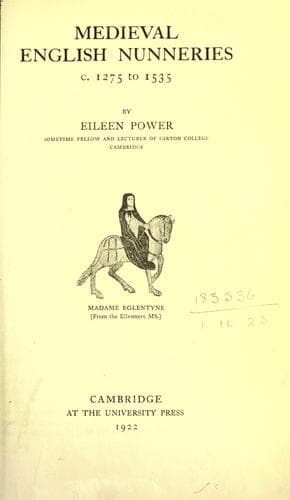
Medieval English Nunneries c. 1275 to 1535Power, Eileen
History
Medieval English Nunneries c. 1275 to 1535
Power, Eileen
Convents -- England; Monastic and religious life of women -- History
It is tempting to conjecture what considerations may have prevailed to
make some houses substitute money grants for the provision of food in
kind. The tendency certainly grew with the custom of forming _familiae_
which messed separately and it certainly increased with time. Even at
Catesby, which we saw to be a typical example of communal housekeeping in
1414-5, it seems to have become customary to give money for some at least
of the victuals in 1442. The tendency also grew with poverty, as appears
from Alnwick's visitations, though it is not clear whence the nuns
obtained the wherewithal to feed themselves adequately, unless they had
the use of extra funds of their own. It may also be conjectured that the
system would be easier to work in a town than in the depths of the
country. In a town the nuns could buy in the open market, and it was as
easy for individuals to buy in small quantities as for the cellaress to
buy wholesale. In the country, however, the convent would not only be more
dependent on the home farm, but such purchases as had to be made at
occasional fairs and weekly markets could more easily be made in bulk, a
consideration which also accounts for the fact that the barrels and cades
of salt fish for Lent were usually laid in wholesale by the cellaress.
Moreover it would often be convenient for a town house to lease out the
greater number of its demesnes and to depend upon what it could purchase
for its daily fare. St Mary de Pre is particularly interesting in this
respect; the 1486-8 account shows no sign of any home farm; the income of
the house is derived almost entirely from "rents of assise and rents farm"
within the town of St Albans and in other places and from tithes, and the
proportion of farms or leases is noticeably large. Even the bread and beer
distributed among the sisters did not come from a home farm; it was bought
with 52_s._ received from the Abbot of St Albans for that purpose; the
kitchener of the parent abbey similarly provided the nuns with 12_s._,
"for potage money departyd amongs the susters for a yere," and at the
forester's office they received 8_s._ for their fuel.
Occasional references show what a variety of household charges the nuns
sometimes had to bear out of their _peculia_, and the other sources of
their private income. At Campsey in 1532, for instance,
the subprioress says that the prioress will not allow her servants to
go out upon the necessary errands of the nuns, but they hire outsiders
at their own cost and Dame Isabella Norwiche says that sick nuns in
the time of their sickness bear the cost of what is needful to them
and it is not provided at the charge of the house[1043].
Public-domain text, read in full here on John Shaqi.
Reviews
Reviews
No reviews yet
Be the first to share your thoughts on this work.
Elsewhere in the archive
Join the Discussion
Join the discussion
Sign in to leave a comment or review.
Sign InorCreate an account