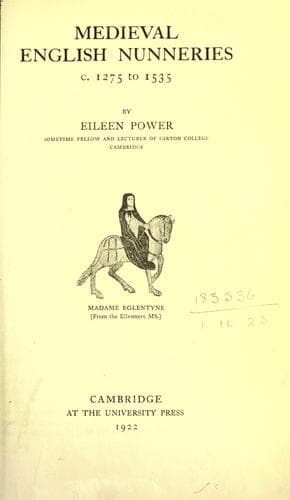
Medieval English Nunneries c. 1275 to 1535Power, Eileen
History
Medieval English Nunneries c. 1275 to 1535
Power, Eileen
Convents -- England; Monastic and religious life of women -- History
At Sheppey also, in 1511, there was no infirmary and when ill the nuns had
to hire women for themselves and pay for them out of their own
money[1044]. At Langley in 1440 Alnwick ordered that each nun should have
yearly a cartload of fuel, cut at the cost of the house, but carried at
the cost of the nuns[1045]. At Wherwell there was a custom by which, on
the first occasion that a nun took her turn in reading from the pulpit, a
certain sum of money or a pittance was exacted from her for the benefit of
the convent, a custom forbidden by Bishop John of Pontoise in 1302[1046];
and there is mention of another pittance in 1311, when Bishop Woodlock
ordered that for digging the grave and preparing the coffin of a nun who
had died and for pittances to the sisters on the day of her burial, the
goods of the deceased nun should not be expended, because she ought not to
have private property, but the common goods of the church were to be
spent; which seems like locking the stable door after the horse has
gone[1047].
It is interesting to trace the attitude of ecclesiastic authorities to
these various manifestations of _proprietas_. The bishops found some
difficulty in persuading nuns, accustomed to expend money for themselves
and to dine in _familiae_ in separate rooms, accustomed also to receive
gifts and legacies in money and kind, that they must hold all things in
common. At Arthington, in 1307, two nuns, Agnes de Screvyn (who had
resigned the post of Prioress in 1303) and Isabella Couvel, asserted that
certain animals and goods belonging to the priory were their private
property and Archbishop Greenfield bids the Prioress admonish them to
resign these within three days "to lawful and honest uses," according to
her judgment[1048]. Similarly Bishop Bokyngham writes to Heynings in 1392:
We order that cows, sows, capons, hens and all animals of any kind
soever, together with wild or tame birds, which are held by certain of
the nuns (whether with or without licence) ... shall be delivered up
to the common use of the convent within three days, without the
alienation or subtraction of any of them[1049].
In the light of these passages it is interesting to find that cows and
pigs are among the legacies sometimes left to nuns[1050]. At Nuncoton, in
1440, where certain nuns were in the habit of wandering in their gardens
and gathering herbs instead of attending Compline,
Dame Alice Aunselle prays that they may all live in common and that no
nun may have anything, such as cups and the like, as her own; but that
if any such there be, they be kept in common by their common servant
and that they may not have houses or separate gardens appointed, as it
were, to them[1051],
Public-domain text, read in full here on John Shaqi.
Reviews
Reviews
No reviews yet
Be the first to share your thoughts on this work.
Elsewhere in the archive
Join the Discussion
Join the discussion
Sign in to leave a comment or review.
Sign InorCreate an account