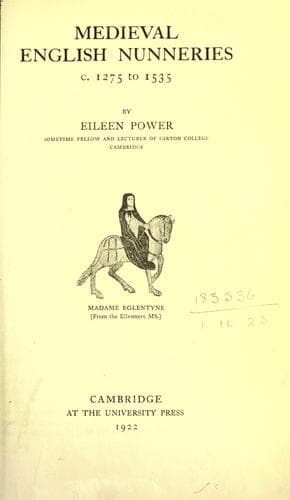
Medieval English Nunneries c. 1275 to 1535Power, Eileen
History
Medieval English Nunneries c. 1275 to 1535
Power, Eileen
Convents -- England; Monastic and religious life of women -- History
which illustrates how easily the household system slid into _proprietas_.
It was sometimes even necessary to forbid nuns to make wills and bequeath
their property. This was forbidden by the Council of Oxford in 1222[1052]
and in 1387 William of Wykeham sent a stern injunction to the nuns of
Romsey, pointing out that by making wills they were falling into the sin
of property[1053]. In 1394, on the death of Joan Furmage, Abbess of
Shaftesbury,
the bishop ordered the Abbey to be sequestrated and annulled the will
by which she had alienated the goods of the house in bequests to
friends, declaring such a disposition to be injurious to the community
and contrary to the usage of religious women[1054].
The history of the attitude of ecclesiastical authorities to two sources
of private income, the _peculium_ and the gifts from friends to
individuals, is of even greater significance than these attempts to cope
with private goods, for it shows how powerless the bishops were against
the steady weakening of discipline in monastic houses. Here, as in the
enclosure struggle and the struggle against _familiae_, they were forced
into compromise at best and at worst into acquiescence. At its first
appearance the custom of giving a _peculium_ to individuals was severely
condemned as a manifest breach of the rule:
"Moneys shall not be assigned to each separately for clothes," says
the Council of Oxford in 1222, "But such shall be diligently attended
to by certain persons deputed to this purpose, chamberers or
chambresses, who according to the need of each and the resources of
the house, shall minister garments to them.... Also it shall not be
lawful for the chamberer or chambress to give to any monk, canon or
nun, monies or anything else for clothes, nor shall it be lawful for
monk, canon or nun to receive anything; otherwise let the chamberer be
deposed from office and the monk, canon or nun go without new clothes
for that year"[1055].
Public-domain text, read in full here on John Shaqi.
Reviews
Reviews
No reviews yet
Be the first to share your thoughts on this work.
Elsewhere in the archive
Join the Discussion
Join the discussion
Sign in to leave a comment or review.
Sign InorCreate an account