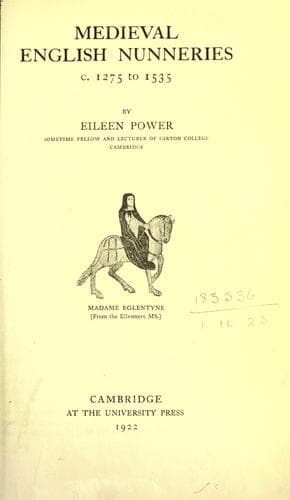
Medieval English Nunneries c. 1275 to 1535Power, Eileen
History
Medieval English Nunneries c. 1275 to 1535
Power, Eileen
Convents -- England; Monastic and religious life of women -- History
Similarly, in the Constitutions of the legate Ottobon in 1268, the
_peculium_ is grouped with other forms of property; ch. XL enacts that no
religious is to possess property and that the head of the house is to make
diligent search for such property twice a year[1056], and ch. XLI enacts
that no money is to be given to a religious for clothes, shoes and other
necessities, but he is to be given the article itself[1057]. In 1438 a
severe injunction from Bishop Spofford of Hereford to the nuns of Aconbury
shows the close connection between the _peculium_ and the private _camera_
of the nuns[1058]. Yet in 1380 we find a bishop of Salisbury assigning a
weekly allowance of 2_d._ to each nun of Shaftesbury from the issues of
the house[1059]; and in the fifteenth and sixteenth centuries nuns
regularly complain to their visitors when their allowances are in arrears
and the bishops regularly ordain that the money is to be paid[1060]. In
the thirteenth century it is a fault in the Prioress to give the nuns a
_peculium_; in the fifteenth century it is a fault to withhold it.
The custom as to presents from friends was that the nuns might receive
gifts, only by the permission of their superior, to whom everything must
be shown[1061]. Thus Archbishop Wickwane writes to Nunappleton in 1281:
"that no nun shall appropriate to herself any gift, garment or shoes of
the gift of anyone, without the consent and assignment of the
prioress"[1062]; Archbishop Greenfield in 1315 forbids the nuns of
Rosedale to accept or give any presents without the consent of the
Prioress[1063]; and Archbishop Bowet in 1411 enacts that any nun of
Hampole receiving gifts or _legacies_ from friends is at once on returning
to reveal them to the Prioress[1064]. Occasionally a Prioress, whether out
of zeal for the Rule or for some other reason, showed herself unwilling to
allow the nuns to receive presents. The nuns of Flixton in 1514
complained: "that they receive no annual pensions and that the prioress is
angry when anything is given to them by their friends"[1065] and Alnwick
in 1441 wrote to the Prioress of Ankerwyke, whose nuns complained both of
insufficient clothes and of her bad temper when their friends came to see
them,
And what euer thise saide frendes wyll gyfe your sustres in relefe of
thaym as in hire habyte and sustenaunce, ye suffre your sustres to
take hit, so that no abuse of euel come therbye noyther to the place
ne to the persones therof[1066].
It was indeed almost a necessity to encourage the reception of presents,
when (as so often happened towards the close of the middle ages) nuns were
dependent for clothes upon their friends. But with Bishop Praty ordering
that the nuns of Easebourne shall receive half the sums paid them for
their work, and with Bishop Alnwick encouraging presents and enforcing the
payment of _peculia_, it is plain that the Lady Poverty had fallen upon
evil days.
CHAPTER IX
FISH OUT OF WATER
Public-domain text, read in full here on John Shaqi.
Reviews
Reviews
No reviews yet
Be the first to share your thoughts on this work.
Elsewhere in the archive
Join the Discussion
Join the discussion
Sign in to leave a comment or review.
Sign InorCreate an account