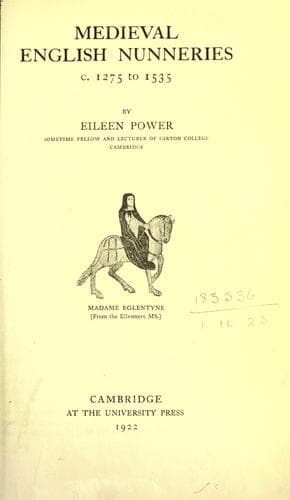
Medieval English Nunneries c. 1275 to 1535Power, Eileen
History
Medieval English Nunneries c. 1275 to 1535
Power, Eileen
Convents -- England; Monastic and religious life of women -- History
De sorte qu'une Religieuse hors de sa cloture est comme une pierre
hors de son centre; comme un arbre hors de terre; comme Adam et Eve
hors du Paradis terrestre; comme le corbeau hors de l'arche qui ne
s'arreste qu'a des charognes; comme un poisson hors de l'eau, selon le
grand Saint Antoine et Saint Bernard; comme une brebis hors de sa
bergerie et en danger d'estre devoree des loups, selon Saint Theodore
Studite; comme un oiseau hors de son nid et une grenouille hors de son
marais, selon le meme Saint Bernard; comme un mort hors de son
tombeau, qui infecte les personnes qui s'en approchent, selon Pierre
le Venerable et la Regle attribuee a Saint Jerome; et par consequent
dans un etat tout a fait oppose a la vie Reguliere qu'elle a
embrassee.
J. B. THIERS (1681).
The famous chapter LXVI of the Benedictine Rule enunciated the principle
that the professed monk should remain within the precincts of his cloister
and eschew all wandering in the world[1067]. It is clear, however, that
the Rule allowed a certain latitude and that monks and nuns were to be
allowed to leave their houses under certain conditions and for necessary
causes. Brethren working at a distance or going on a journey may be
excused attendance at the divine office, if they cannot reach the church
in time[1068]. Brethren sent upon an errand are forbidden to accept
invitations to eat outside the house without the consent of their
superior[1069]. Moreover longer journeys are plainly contemplated, in
which they might have to spend a night or more outside their
monastery[1070]. But no one might ever leave the cloister bounds without
the permission of the superior; and it was the obvious intention of St
Benedict to reduce to a minimum all wandering in the world. Strictly
speaking this system of enclosure applied equally to monks and to nuns;
but from the earliest times it was considered to be a more vital necessity
for the well being of the latter; and the history of the enclosure
movement is in effect the history of an effort to add a fourth vow of
claustration to the three cardinal vows of the nun[1071]. The reasons for
this severity are sufficiently obvious, and show that curious
contradiction of ideas which is so common in all general theories about
women. On the one hand the immense importance attached by the medieval
Church to the state of virginity, exemplified in St John Chrysostom's
remarks that Christian virgins are as far above the rest of mankind as are
the angels, made it all important that this priceless jewel should not be
exposed to danger in a wicked world[1072]. On the other hand the medieval
contempt for the fragility of women led to a cynical conviction that only
when they were shut up behind the high walls of the cloister was it
possible to guarantee their virtue; _aut virum aut murum oportet mulierem
habere_[1073]. Both views received support from the deep-rooted idea as
Public-domain text, read in full here on John Shaqi.
Reviews
Reviews
No reviews yet
Be the first to share your thoughts on this work.
Elsewhere in the archive
Join the Discussion
Join the discussion
Sign in to leave a comment or review.
Sign InorCreate an account