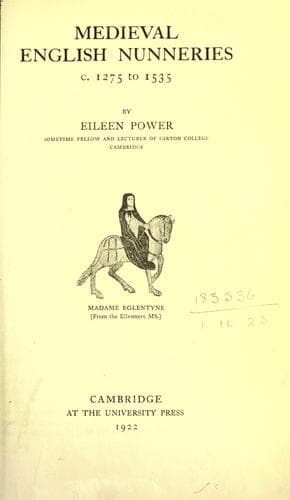
Medieval English Nunneries c. 1275 to 1535Power, Eileen
History
Medieval English Nunneries c. 1275 to 1535
Power, Eileen
Convents -- England; Monastic and religious life of women -- History
old as the Greeks and an unconscionable time in dying, that "a free woman
should be bounded by the street door"[1074]. Medieval moralists were
generally agreed that intercourse with the world was at the root of all
those evils which dimmed the fair fame of the conventual system, by
affording a constant temptation to frivolity and to grosser misconduct.
Moreover the tongue of scandal was always busy and the nun's reputation
was safe only if she could be placed beyond reproach. Hence those
regulations which Mr Coulton compares to "the minutely ingenious and
degrading precautions of an oriental harem"[1075].
Based upon such considerations as these, the movement for the enclosure of
nuns began very early in their history and continued with unabated vigour
long after the Reformation[1076]. Some years before the compilation of the
Benedictine Rule St Caesarius of Arles, in his Rule for nuns, had
forbidden them ever to leave their monastery; and from the sixth to the
eleventh century decrees were passed from time to time by various
provincial councils, advocating a stricter enclosure of monks and nuns,
but especially of the latter. Already by the twelfth century monasticism
had declined from its first fervour, and it is significant that the
reformed orders which sprang up during the great renaissance of that
century all made a special effort to enforce enclosure upon their nuns.
The nuns of Premontre and Fontevrault were strictly enclosed and in the
middle of the following century the statutes promulgated by the
Chapter-General of the Cistercian Order (1256-7) contain a clause ordering
nuns to remain in their convents, except under certain specified
conditions, while the rule given by Urban IV to the Franciscan nuns (1263)
went further than any previous enactments in binding them by a vow of
perpetual enclosure, against which no plea of necessity might avail.
Various synods and councils continued to repeat the order that nuns were
not to leave their houses, except for a reasonable cause, but it is plain
from the evidence of ecclesiastics, moralists and episcopal visitations
that the nuns all over Europe paid small heed to their words. Finally, at
the beginning of the new century, came the first general regulation on the
subject which was binding as a law upon the whole church, the famous Bull
_Periculoso_, promulgated by Boniface VIII about the year 1299.
This decree, often afterwards confirmed by Popes and Councils, remained
the standard regulation upon the subject and in view of its cardinal
importance its terms are worthy of notice:
Public-domain text, read in full here on John Shaqi.
Reviews
Reviews
No reviews yet
Be the first to share your thoughts on this work.
Elsewhere in the archive
Join the Discussion
Join the discussion
Sign in to leave a comment or review.
Sign InorCreate an account