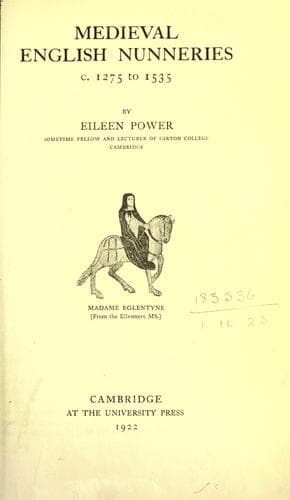
Medieval English Nunneries c. 1275 to 1535Power, Eileen
History
Medieval English Nunneries c. 1275 to 1535
Power, Eileen
Convents -- England; Monastic and religious life of women -- History
Desiring to provide for the perilous and detestable state of certain
nuns, who, having slackened the reins of decency and having
shamelessly cast aside the modesty of their order and of their sex,
sometimes gad about outside their monasteries in the dwellings of
secular persons, and frequently admit suspected persons within the
same monasteries, to the grave offence of Him to Whom they have, of
their own will, vowed their innocence, to the opprobrium of religion
and to the scandal of very many persons; we by the present
constitution, which shall be irrefragably valid, decree with healthful
intent that all and sundry nuns, present and future, to whatever order
they belong and in whatever part of the world, shall henceforth remain
perpetually enclosed within their monasteries; so that no nun tacitly
or expressly professed in religion shall henceforth have or be able to
have the power of going out of those monasteries for whatsoever reason
or cause, unless perchance any be found manifestly suffering from a
disease so great and of such a nature that she cannot, without grave
danger or scandal, live together with others; and to no dishonest or
even honest person shall entry or access be given by them, unless for
a reasonable and manifest cause and by a special licence from the
person to whom [the granting of such a licence] pertains; that so,
altogether withdrawn from public and mundane sights, they may serve
God more freely and, all opportunity for wantonness being removed,
they may more diligently preserve for Him in all holiness their souls
and their bodies.
The Bull further, in order to avoid any excuse for wandering abroad in
search of alms, forbids the reception into any non-mendicant order of more
sisters than can be supported without penury by the goods of the house;
and, in order to prevent nuns being forced to attend lawcourts in person,
requires all secular and ecclesiastical authorities to allow them to plead
by proctors in their courts; but if an Abbess or Prioress has to do
personal homage to a secular lord for any fief and it cannot be done by a
proctor, she may leave her house with honest and fit companions and do the
homage, returning home immediately. Finally Ordinaries are enjoined to
take order as soon as may be for proper enclosure where there is none to
provide that it is strictly kept according to the terms of the decree, and
to see that all is completed by Ash Wednesday, notifying any reasonable
impediment within eight days of Candlemas[1077].
Public-domain text, read in full here on John Shaqi.
Reviews
Reviews
No reviews yet
Be the first to share your thoughts on this work.
Elsewhere in the archive
Join the Discussion
Join the discussion
Sign in to leave a comment or review.
Sign InorCreate an account