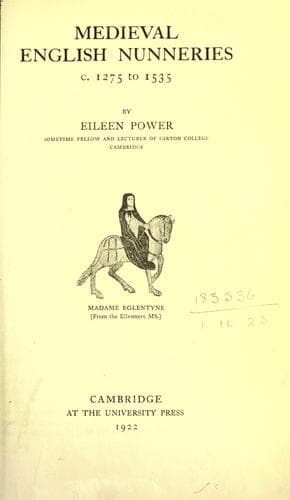
Medieval English Nunneries c. 1275 to 1535Power, Eileen
History
Medieval English Nunneries c. 1275 to 1535
Power, Eileen
Convents -- England; Monastic and religious life of women -- History
For the next three centuries Councils and Bishops struggled manfully to
put into force the Bull _Periculoso_, but without success; the constant
repetition of the order that nuns should not leave their convents is the
measure of its failure. In the various reformed orders, which were founded
in the fifteenth and sixteenth centuries, the insistence upon enclosure
bears witness to the importance which was attached to it as a vital
condition of reform: Boniface IX's ordinances for the Dominicans (1402),
St Francis of Paula's rule for his order in Calabria (1435), the rule of
the Order of the Annunciation, founded by Jeanne, daughter of Louis XI, at
the close of the fifteenth century, Johann Busch's reforms in Saxony, the
reformed rules given by Etienne Poncher, Bishop of Paris, to the nuns of
Chelles, Montmartre and Malnoue (1506) and by Geoffrey de Saint Belin,
Bishop of Poitiers, to the nuns of the Holy Cross, Poitiers (1511), all
insist upon strict enclosure[1078]. Similarly a long list might be drawn
up of general and provincial councils and synods which repeated the
ordinance, culminating in the great general Council of Trent, which
renewed the decree _Periculoso_ and was itself followed by another long
series of provincial councils, which endeavoured to put its decree into
force. But these efforts were still attended by very imperfect success,
for the worldly nuns of the sixteenth and seventeenth centuries chafed at
the irksome restriction no less than did their predecessors of the middle
ages. When, in 1681, Jean-Baptiste Thiers published his treatise on the
enclosure of nuns he announced his reason to be that no point of
ecclesiastical discipline was in his day more completely neglected and
ignored[1079].
Public-domain text, read in full here on John Shaqi.
Reviews
Reviews
No reviews yet
Be the first to share your thoughts on this work.
Elsewhere in the archive
Join the Discussion
Join the discussion
Sign in to leave a comment or review.
Sign InorCreate an account