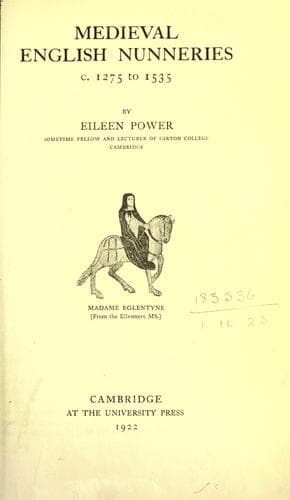
Medieval English Nunneries c. 1275 to 1535Power, Eileen
History
Medieval English Nunneries c. 1275 to 1535
Power, Eileen
Convents -- England; Monastic and religious life of women -- History
This brief sketch of the enclosure movement in the Western Church is
necessary to a right understanding of the special attempts which were made
in England to keep the nuns in their cloisters by means of an absolute
enforcement of the Benedictine Rule. Visitatorial injunctions on this
subject during the fourteenth and fifteenth centuries and up to the
Reformation were based upon three enactments: the constitutions of the
legate Ottobon in 1268, the vigorous reforms of Archbishop Peckham
(1279-92) and the Bull _Periculoso_. The Cardinal Legate Ottobon had come
to England in 1265, on the restoration of Henry III after Evesham, with
the purpose of punishing bishops and clergy who had supported the party of
Simon de Montfort and the barons. When peace was finally signed in 1267,
largely by his intervention, he was able to turn his attention to general
abuses prevalent in the English church and one of the reforms which he
attempted to enforce was the stricter enclosure of nuns. Chapter LII of
his _Constitutions_ [_Quod moniales a certis locis non exeant_] is an
amplification of the Benedictine rule of enclosure, made far more rigid
and severe. "Lest by repeated intercourse with secular folk the quiet and
contemplation of the nuns should be troubled," minute regulations were
laid down as to their movements. They were allowed to enter their chapel,
chapter, dorter and frater at due and fixed times; otherwise they were to
remain in the cloister; and none of these places were to be entered by
seculars, save very seldom and for some sufficient reason. No nun was to
converse with any man, except seriously and in a public place, and at
least one other nun was always to be present at such conversations. No nun
was to have a meal outside the house except with the permission of the
superior and then only with a relative, or some person from whose company
no suspicion could arise. All other places, beyond those specified, were
entirely forbidden to the nuns, with the exception, in certain
circumstances, of the infirmary. No nun was to go to the different
offices, except the obedientiaries, whose duties rendered it necessary and
they were never to go without a companion. The Abbess or head of the house
was never to leave it, except for its evident advantage or for urgent
necessity, and she was always to have an honest companion, while the
lesser nuns were never to be given licence to go out, except for some fit
cause and in company with another nun. Finally nuns were not to leave
their convents for public processions, but were to hold their processions
within the precincts of their own houses. The legate strictly enjoined
that "the prelates to whose jurisdiction belonged the visitation of each
nunnery should cause these statutes to be observed"[1080].
Public-domain text, read in full here on John Shaqi.
Reviews
Reviews
No reviews yet
Be the first to share your thoughts on this work.
Elsewhere in the archive
Join the Discussion
Join the discussion
Sign in to leave a comment or review.
Sign InorCreate an account