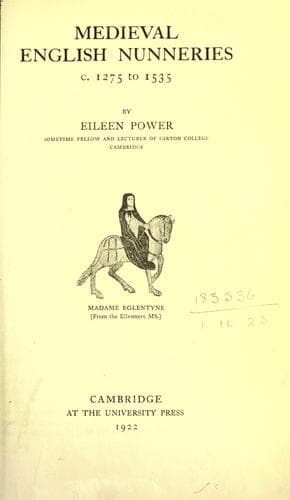
Medieval English Nunneries c. 1275 to 1535Power, Eileen
History
Medieval English Nunneries c. 1275 to 1535
Power, Eileen
Convents -- England; Monastic and religious life of women -- History
It will be realised that these injunctions were exceedingly severe and
that the visitors were not likely to find their task a sinecure. There is
little evidence for determining how far any serious attempt was made to
enforce the legate's Constitutions[1081], but if we may judge from the
language of Peckham, some ten years later, any attempts which may have
been made had not been strikingly successful. One of the first actions of
this energetic archbishop on his elevation to the see of Canterbury was to
carry out a visitation of the nunneries of Barking and Godstow and to
send to both houses injunctions laying great stress on strict enclosure
(1279). In 1281 he followed up these injunctions by two general decrees
for the enclosure of nuns; and in 1284 he visited the three nunneries of
Romsey, Holy Sepulchre (Canterbury) and Usk and sent injunctions enforcing
the Constitutions of 1281[1082]. In these injunctions he laid down with
great exactness the conditions to be observed in granting nuns permission
to leave their convents. The Godstow injunction runs thus:
For the purpose of obtaining a surer witness to chastity, we ordain
that nuns shall not leave the precincts of the monastery, save for
necessary business which cannot be performed by any other persons.
Hence we condemn for ever, by these present [letters] those sojourns
which were wont to be made in the houses of friends, for the sake of
pleasure and of escaping from discipline [_ad solatium et ad
subterfugium disciplinae_]. And when it shall befall any [nuns] to go
out for any necessity, we strictly order these four [conditions] to be
observed. First, that they be permitted to go out only in safe and
mature company, as well of nuns as of secular persons helping them.
Secondly that having at once performed their business, so far as it
can be by them performed, they return to their house; and if the
performance of the business demand a delay of several days, after the
first or second day it shall be left to proctors to finish it. Thirdly
that they never lodge in the precincts of men of religion or in the
houses of clergy, or in other suspected habitations. Fourthly that no
one absent herself from the sight of her companion or companions, in
any place where human conversation might be held, nor listen to any
secret whispering, except in the presence of the nuns her companions,
unless perchance father or mother, brother or sister have something
private to say to her[1083].
Public-domain text, read in full here on John Shaqi.
Reviews
Reviews
No reviews yet
Be the first to share your thoughts on this work.
Elsewhere in the archive
Join the Discussion
Join the discussion
Sign in to leave a comment or review.
Sign InorCreate an account