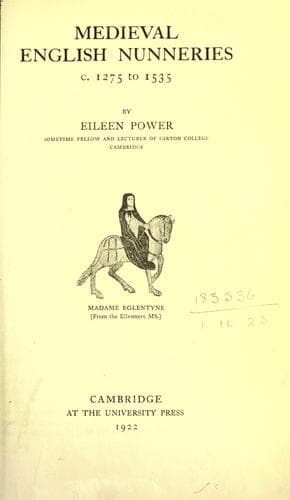
Medieval English Nunneries c. 1275 to 1535 — John Shaqi
Medieval English Nunneries c. 1275 to 1535Power, Eileen
History
Medieval English Nunneries c. 1275 to 1535
Power, Eileen
Convents -- England; Monastic and religious life of women -- History
Romeyn described Margaret de la Batayle, whom he sent to Sinningthwaite,
as "_juvencula_"[110]. The great Peckham went out of his way to make a
specific defence of the practice in 1282, when the Prioress and Convent of
Stratford sought to excuse themselves from veiling a little girl called
Isabel Bret, by reason of her youth, "since on account of this minority
she is the more able and capable to learn and receive those things which
concern the discipline of your order"[111].
It is impossible to make the generalisation that even children professed
at such an early age could have had no consciousness of a vocation for the
religious life; the history of some of the women saints of the middle ages
would be enough to disprove this[112]. The German monk Caesarius of
Heisterbach, who is to be equalled as a gossip only by the less pious
Salimbene, has some delightful stories of youthful enthusiasts in the
_Dialogus Miraculorum_, which he wrote between 1220 and 1235 for the
instruction of the novices in his own Cistercian house. One child,
destined for a worldly match, protests daily that she will wed Christ
only; and, when forced to wear rich garments, asserts "even if you turn me
to gold you cannot make me change my mind," until her parents, worn out by
her prayers, allow her to enter a nunnery where, although very young, she
is soon made governess of the novices. Her sister, given to an earthly
husband while yet a child, is widowed and, "_ipsa adhuc adolescentula_"
enters the same house. Another girl, fired by their example, escapes to a
nunnery in man's clothes; her sister, trying to follow, is caught by her
parents and married, "but I hope," says the appreciative Caesarius, "that
God may not leave unrewarded so fervent a desire to enter religion"[113].
But the most charming tale of all is that of the conversion of Helswindis,
Abbess of Burtscheid[114].
Public-domain text, read in full here on John Shaqi.
Reviews
Reviews
No reviews yet
Be the first to share your thoughts on this work.
Join the Discussion
Join the discussion
Sign in to leave a comment or review.
Sign InorCreate an account