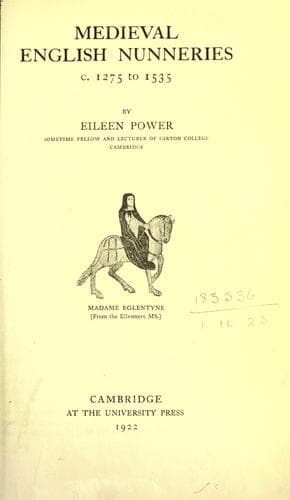
Medieval English Nunneries c. 1275 to 1535Power, Eileen
History
Medieval English Nunneries c. 1275 to 1535
Power, Eileen
Convents -- England; Monastic and religious life of women -- History
The nunnery as a career and as a vocation does not need separate
treatment. It has already been shown that in large families it was a very
usual custom to make one or more of the daughters nuns. Indeed the youth
of many of the girls who took the veil is in itself proof that anything
like a vocation, or even a free choice, was seldom possible and was hardly
anticipated, even in theory. The age of profession was sixteen, but much
younger children were received as novices and prepared for the veil; they
could withdraw if they found the life distasteful, but as a rule, being
brought up from early childhood for this career, they entered upon it as a
matter of course; moreover the Church was rather apt to regard the
withdrawal of novices as apostasy. Sir Guy de Beauchamp in his will (dated
1359) describes his daughter Katherine as a nun of Shouldham and Dugdale
notes that Katherine, aged seven years, and Elizabeth, aged about one
year, were found to be daughters and heirs of the said Guy, who died in
the following year[102]. It might be supposed that this child of seven was
being brought up as a lay boarder in the convent, but legacies left to
Katherine "a nun at Shouldham" by her grandfather and by her uncle, in
1369 and in 1400 respectively, show that she had been thus vowed in
infancy to a religious life[103]. One of the daughters of Thomas of
Woodstock Duke of Gloucester, was "in infancy placed in the monastery (of
the Minoresses without Aldgate) and clad in the monastic habit" and in
1401 the Pope gave her permission to leave it if she wished, but she
remained and became its abbess[104]. Bishops' registers constantly give
evidence of the presence of mere children in nunneries. When Alnwick
visited Ankerwyke in 1441, three of the younger nuns complained that they
lacked a teacher (_informatrix_) to teach them "reading, song, or
religious observance"; and at the end of the visitation the Bishop noted
that he had examined all the nuns save three, whom he had omitted "on
account of the heedlessness of their age and the simplicity of their
discretion, since the eldest of them is not older than thirteen
years"[105]. At Studley in 1445 he found a girl who had been in religion
for two years and was then thirteen; she complained that one of the
maid-servants had slapped a fellow nun (doubtless also a child) in
church![106] At Littlemore there was a certain Agnes Marcham, who had
entered at the age of thirteen, and had remained there unprofessed for
thirteen years; she now refused to take the full vows[107]. Some of the
nuns at Romsey in 1534 were very young, two being fourteen and one
fifteen[108]. Indeed the reception of girls at a tender age was rather
encouraged than otherwise by the Church. Archbishop Greenfield gave a
licence to the Prioress of Hampole to receive Elena, daughter of the late
Reyner Sperri, citizen of York, who was eight years old, and (he added
solemnly) "of good conversation and life"[109], and Archbishop John le
Public-domain text, read in full here on John Shaqi.
Reviews
Reviews
No reviews yet
Be the first to share your thoughts on this work.
Join the Discussion
Join the discussion
Sign in to leave a comment or review.
Sign InorCreate an account