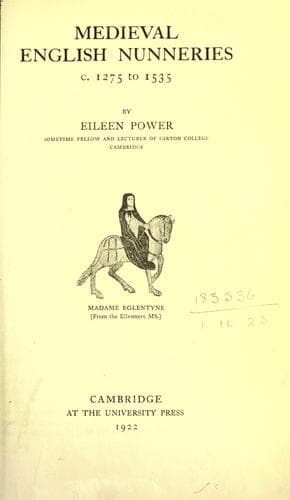
Medieval English Nunneries c. 1275 to 1535Power, Eileen
History
Medieval English Nunneries c. 1275 to 1535
Power, Eileen
Convents -- England; Monastic and religious life of women -- History
Dalderby's experience at Markyate shows that John of Ayton's picture was
not too highly coloured, and since it was impossible to enforce "hard and
intolerable restrictions" without at least a measure of co-operation from
the nuns themselves, the bishops took the only course open to them in
trying to minimise the evil. Their expedients deserve some study, and as a
typical set of episcopal injunctions dealing with journeys by nuns outside
their cloisters it will suffice to quote those sent by Walter Stapeldon,
Bishop of Exeter, to the nunneries of Polsloe and Canonsleigh. These rules
were drawn up in 1319, only twenty years after the publication of the Bull
_Periculoso_, but they are already far removed from the strict ideal of
Boniface VIII. Stapeldon was a practical statesman and he evidently
realised that the enforcement of strict enclosure was impossible in a
diocese where the nuns had been used to considerable freedom and where all
the counties of the West saw them upon their holidays.
The clauses dealing with the subject run as follows:
_De visitacione amicorum._ No lady of religion is to go and visit her
friends outside the priory, but if it be once a year at the most and
then for reasonable cause and by permission; and then let her have a
companion professed in the same religion, not of her own choice, but
whomsoever the Prioress will assign to her and she who is once
assigned to her for companion shall not be assigned the next time, so
that each time a lady goes to visit her friends her companion is
changed; and if she have permission to go to certain places to visit
her friends, let her not go to other places without new permission.
_De absencia Dominarum et regressu earum._ Item, when any lady of
religion eats at Exeter, or in another place near by, for reasonable
cause and by permission, whenever she can she ought to return the same
or the following day and each time let her have a companion and a
chaplain, clerk or serving-man of good repute assigned by the
prioress, who shall go, remain and return with them and otherwise they
shall not go; and then let them return speedily to the house, as they
be commanded, and let them not go again to Exeter, wandering from
house to house, as they have oftentimes done, to the dishonour of
their state and of religion. _De Dominabus "Wakerauntes"_ [i.e.
_vagantibus_]. Item, a lady who goes a long distance to visit her
friends, in the aforesaid form, should return to the house within a
month at the latest, or within a shorter space if it be assigned her
by the Prioress, having regard to the distance or proximity of the
place, where dwell the friends whom she is going to visit, but a
longer term ought the Prioress never to give her, save in the case of
death, or of the known illness of herself or of her near friends.
_Pena Dominarum Vagancium._ And if a lady remain without for a long
Public-domain text, read in full here on John Shaqi.
Reviews
Reviews
No reviews yet
Be the first to share your thoughts on this work.
Elsewhere in the archive
Join the Discussion
Join the discussion
Sign in to leave a comment or review.
Sign InorCreate an account