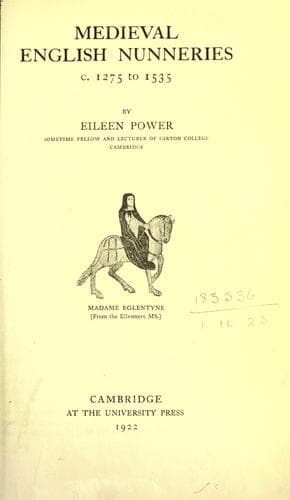
Medieval English Nunneries c. 1275 to 1535Power, Eileen
History
Medieval English Nunneries c. 1275 to 1535
Power, Eileen
Convents -- England; Monastic and religious life of women -- History
time or in any other manner than in the form aforesaid, let her never
set foot outside the outer gate of the Priory for the next two years;
and nevertheless let her be punished otherwise for disobedience, in
such manner as is laid down by the rule and observances of the order
of St Benet for the fault; and leave procured by the prayer of her
friends ought not to excuse her from this penance[1102]. No lady of
your religion, professed or unprofessed, shall come to the external
offices outside the door of the cloister to be bled or for any other
feigned excuse, save it be by leave of the Prioress or of the
Subprioress, and then for a fit reason and let her have with her
another professed lady of your religion, to the end that each of them
may see and hear that which the other shall say and do[1103].
The main lines along which the bishops attempted to regulate the movements
of the nuns outside their houses appear clearly in these injunctions. It
was their invariable practice to forbid unlicensed visits, in accordance
with the Benedictine rule; no nun might leave her house without a licence
from her superior and such licences were not to be granted too
easily[1104] or with any show of favouritism[1105]; sometimes the licence
of the Bishop was required as well[1106]. Such licences were not to be
granted often (once a year is usually the specified rule)[1107] and the
bishops sometimes tried to confine the visits of nuns to parents or to
near relatives[1108]. An attempt was also made to regulate the length of
the visits. A maximum number of days was fixed and the nun was to be
punished if she outstayed her leave[1109], except when she was detained by
illness. This maximum differed from time to time and from place to place.
Bishop Stapeldon, it will be recalled, allowed the nuns in his diocese to
remain away for a month and longer; how he reconciled such laxity with his
conscience and the Bull _Periculoso_ is not plain. Archbishop Greenfield,
at the same date, permitted his Yorkshire nuns a maximum visit of fifteen
days[1110], and in 1358 Bishop Gynewell of Lincoln forbade the nuns of
Godstow to remain away for longer than three weeks[1111]. When Alnwick
visited the diocese of Lincoln in 1440-5, he made careful inquiry into
the length of the visits paid by the nuns and at Goring, Gracedieu,
Markyate, Nuncoton and St Michael's, Stamford, he found that the superior
usually gave the nuns licence to remain away a week, though the Prioress
of Studley gave exeats for three or four days only[1112]. A week does not
seem a very lengthy absence, but Alnwick would have lifted horrified
eyebrows at the action of his predecessor Gynewell, for he ordered the
superiors "that ye gyfe no sustere of yowres leue to byde wythe thaire
frendes whan thai visite thaym, overe thre dayes in helthe, and if thai
falle seke, that he do fecche thaym home wythe yn sex dayes"[1113]. He
Public-domain text, read in full here on John Shaqi.
Reviews
Reviews
No reviews yet
Be the first to share your thoughts on this work.
Elsewhere in the archive
Join the Discussion
Join the discussion
Sign in to leave a comment or review.
Sign InorCreate an account