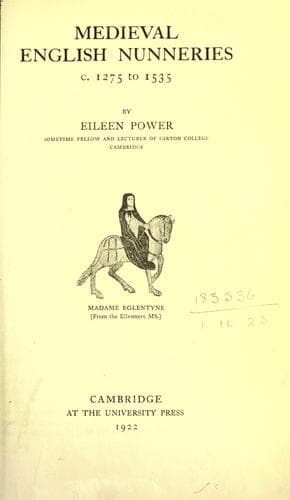
Medieval English Nunneries c. 1275 to 1535Power, Eileen
History
Medieval English Nunneries c. 1275 to 1535
Power, Eileen
Convents -- England; Monastic and religious life of women -- History
shared the views of an even stricter reformer, Peckham[1114]. It was often
stipulated that the nuns, whether they went on long or on short journeys,
were to go only to the place which they had received permission to
visit[1115]; and sometimes they were specially told that if they were
obliged to spend the night away from their friends they were to do so,
whenever possible, in another nunnery[1116]. But they were strictly
forbidden to harbour in the houses of monks, friars, or canons[1117]. On
short journeys, or on errands which could be speedily accomplished, they
were forbidden to eat or drink out of their monasteries or to make
unnecessary delay, but were to return at once and in no case to be out
after nightfall[1118]. Moreover it was invariably ordered that a nun was
on no account to leave her house, without another nun of mature age and
good reputation who would be a constant witness to her behaviour[1119];
and both were to wear monastic dress[1120].
The chief aim of the ecclesiastical authorities was, however, to secure
that leave of absence should be granted only for a reasonable cause. All
conciliar and other injunctions for enclosure added a saving clause of
"manifest necessity" and this gave an opening for an infinite variety of
interpretation. The nuns, indeed, could fall back upon a threefold line of
defence against the intolerable restrictions. They could appeal to the
undoubted fact that strict and perpetual enclosure went beyond the
requirements of their rule. They could adduce the custom by which, as long
as their memory ran, nuns had been allowed to leave their convents under
conditions. Finally they could with a little skill, stretch the "manifest
necessity" clause to cover almost all their wanderings. Thus it happened
that in enforcing the Bull _Periculoso_ the visitors of the later middle
ages found themselves obliged to define, more or less widely according to
local conditions, what was and what was not a reasonable cause, and to
combat one after another certain specific excuses put forward by the nuns.
The sternest reformers were agreed that enclosure might be broken, when
the lives of the nuns were endangered. Fire, flood, famine, war and the
ruin of their buildings were universally accepted as reasonable
excuses[1121]. A nun could leave her house to be superior of another
nunnery (a not infrequent practice), or to found new houses or to
establish reform elsewhere.[1122] Moreover when a culprit stood in need
of condign punishment, she might be and often was sent to another house
to do penance among strangers, who would neither sympathise with her nor
run the risk of being contaminated by her[1123].
Public-domain text, read in full here on John Shaqi.
Reviews
Reviews
No reviews yet
Be the first to share your thoughts on this work.
Elsewhere in the archive
Join the Discussion
Join the discussion
Sign in to leave a comment or review.
Sign InorCreate an account