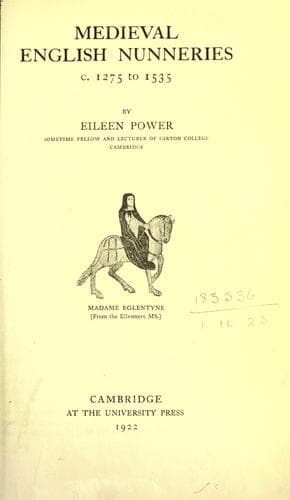
Medieval English Nunneries c. 1275 to 1535Power, Eileen
History
Medieval English Nunneries c. 1275 to 1535
Power, Eileen
Convents -- England; Monastic and religious life of women -- History
After these examples of infant zeal it is impossible to assert that even
the extreme youth of many novices made a real vocation for religious life
impossible. But there is no doubt that such a vocation was less probable,
than in cases when a girl of more mature years entered a convent. And it
is also certain that the tendency to regard monasticism as the natural
career for superfluous girls and as the natural alternative to marriage,
was capable of grave abuse. When medieval convents are compared
unfavourably with those of the present day, and when the increasing laxity
with which the rule was kept in the later middle ages is condemned, it has
always to be remembered that the majority of girls in those days (unlike
those of today) entered the nunneries as a career, without any particular
spiritual qualification, because there was nothing else for them to do.
Even in the fourteenth and fifteenth centuries monasticism produced
saintly women and great mystics (especially in Germany); but it is
remarkable that in England, although there must have been many good
abbesses like Euphemia of Wherwell, there are no outstanding names.
Monasticism was pre-eminently a respectable career.
It has been said that this tendency to regard monasticism as a career was
capable of abuse; and there were not wanting men to abuse it and to use
the nunnery as a "dumping ground" for unwanted and often unwilling girls,
whom it was desirable to put out of the world, by a means as sure as death
itself and without the risk attaching to murder. Kings themselves were
wont thus to immure the wives and daughters of defeated rebels. Wencilian
(Gwenllian) daughter of Llewelyn was sent to Sempringham as a child, after
her father's death in 1283, and died a nun there in 1337, and the two
daughters of Hugh Despenser the elder were forced to take the veil at the
same convent after their father's fall[116]. The nunnery must often have
served the purpose of lesser men, desirous of shaking off an encumbrance.
The guilty wife of Sir Thomas Tuddenham, unhappily married for eight years
and ruined by an intrigue with her father's servant, was sent to
Crabhouse, where she lived for some forty years; and none thought kindly
of her save--strangely enough--her husband's sister[117]. Sir Peter de
Montfort, dying in 1367, left ten shillings to the lady Lora Astley, a nun
at Pinley, called by Dugdale "his old concubine"[118]. Illegitimate
children too were sometimes sent to convents. One remembers Langland's
nunnery, where
Dame Iohanne was a bastard,
And dame Clarice a knightes doughter . ac a kokewolde was hire syre.
Public-domain text, read in full here on John Shaqi.
Reviews
Reviews
No reviews yet
Be the first to share your thoughts on this work.
Join the Discussion
Join the discussion
Sign in to leave a comment or review.
Sign InorCreate an account