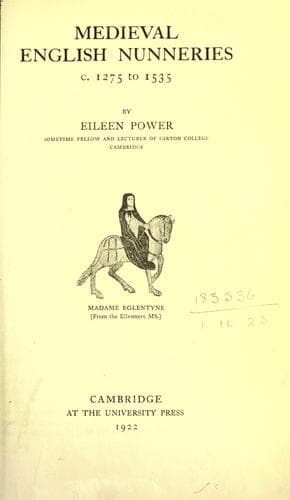
Medieval English Nunneries c. 1275 to 1535Power, Eileen
History
Medieval English Nunneries c. 1275 to 1535
Power, Eileen
Convents -- England; Monastic and religious life of women -- History
Nor were the clergy loath to embrace this opportunity of removing the
fruit of a lapse from grace. Hugh de Tunstede, rector of Catton, left ten
shillings and a bed to his daughter Joan, a nun of Wilberfoss[119], and at
the time of the Dissolution there was a child of Wolsey himself at
Shaftesbury[120]. It is significant that it was sometimes necessary to
procure the papal dispensation of an abbess- or prioress-elect for
illegitimacy, before she could hold office. The dispensation in 1472 of
Joan Ward, a nun of Esholt, who afterwards became prioress, is
interesting, for the Wards were patrons of the house and her presence
illustrates one of the uses to which such patronage could be put[121]. The
diocese of York affords other instances (they were common enough in the
case of priests) of dispensation "_super defectu natalium_"; in 1474 one
was granted to Cecily Conyers, a nun at Ellerton, "born of a married man
and a single woman"[122] and in 1432 Alice Etton received one four days
before her confirmation as Prioress of Sinningthwaite[123]. At St Mary's
Neasham in 1437, the Bishop of Durham appointed Agnes Tudowe prioress and
issued a mandate for her dispensation for illegitimacy and her
installation on the same day[124].
Less defensible from the point of view of the house was the practice,
which certainly existed, of placing in nunneries girls in some way
deformed, or suffering from an incurable defect.
Now earth to earth in convent walls,
To earth in churchyard sod.
I was not good enough for man,
And so am given to God.
It will be remembered that the practice roused the disapprobation of
Gargantua, whose abbey of Theleme contained only beautiful and amiable
persons.
Item, parcequ'en icelluy temps on ne mettoit en religion des femmes,
sinon celles qu'estoyent borgnes, boiteuses, bossues, laides,
deffaictes, folles, insensees, maleficiees et tarees, ... ("a propos,
dist li moyne, une femme qui n'est ny belle, ny bonne, a quoi vault
elle?--A mettre en religion, dist Gargantua.--Voyre, dist le moine, et
a faire des chemises.") ... feut ordonne que la (i.e. a Theleme) ne
seroyent receues, sinon les belles, bien formees et bien naturees, et
les beaux, bien formez et bien naturez[125].
Public-domain text, read in full here on John Shaqi.
Reviews
Reviews
No reviews yet
Be the first to share your thoughts on this work.
Join the Discussion
Join the discussion
Sign in to leave a comment or review.
Sign InorCreate an account