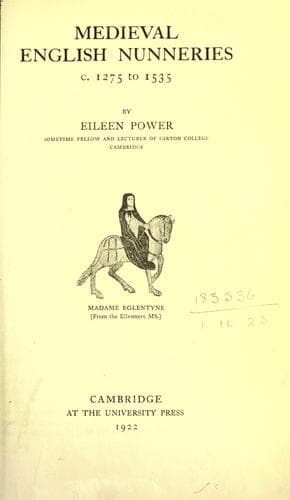
Medieval English Nunneries c. 1275 to 1535Power, Eileen
History
Medieval English Nunneries c. 1275 to 1535
Power, Eileen
Convents -- England; Monastic and religious life of women -- History
Occasionally the nuns seem to have resented or resisted these attempts to
foist the deformed and the half-witted upon them. One of the reasons urged
by the obstinate inmates of Stratford against receiving little Isabel Bret
was that she was deformed in her person[126]. It was complained against
the Prioress of Ankerwyke at Alnwick's visitation in 1441 that she made
_ideotas_ and other unfit persons nuns[127]; and in 1514 the Prioress of
Thetford was similarly charged with intending shortly to receive
illiterate and deformed persons as nuns and especially one Dorothy
Sturges, a deaf and deformed gentlewoman. Her designs were frustrated, but
the nuns of Blackborough were less particular and in 1532 Dorothy answered
among her sisters that nothing was in need of reform in that little
house[128].
At the time of the Dissolution the Commissioners found that one of the
nuns of Langley was "in regard a fool"[129]; and a certain Jane Gowring
(the name of whose convent has not been preserved) sent a petition to
Cromwell, demanding whether two girls of twelve and thirteen, the one deaf
and dumb and the other an idiot, should depart or not[130]. At Nuncoton
in 1440 a nun informed Bishop Alnwick that two old nuns lay in the fermery
and took their meals in the convent's cellar "and likewise the infirm,
_the weak minded_ (_imbecilles_) and they that are in their seynies do eat
in the same cellar"[131]. Complaints of the presence of idiots were fairly
frequent. It is easy to understand the exasperation of Thetford over the
case of Dorothy Sturges, when one finds Dame Katherine Mitford complaining
at the same visitation that Elizabeth Haukeforth is "_aliquando
lunatica_"[132]; but a few years later Agnes Hosey, described as
"_ideota_," gave testimony with her sisters at Easebourne and excited no
adverse comment[133]. In an age when faith and superstition went hand in
hand a mad nun might even bring glory to her house; the tale of Catherine,
nun of Bungay, illustrates this. In 1319 an inquiry was held into the
miracles said to have been performed at the tomb of the saintly Robert of
Winchelsea, Archbishop of Canterbury, whose canonisation was ardently
desired by the English; among these miracles was the following:
Sir Walter Botere, chaplain, having been sworn, says that the miracle
happened thus, to wit that he saw a certain Catherine, who had been
(so they say) a nun of Bungay, in the diocese of Norwich, mad
(_furiosam_) and led to the tomb of the said father; and there she was
cured of the said madness and so departed sane; and he says that there
is public talk and report of this.
Public-domain text, read in full here on John Shaqi.
Reviews
Reviews
No reviews yet
Be the first to share your thoughts on this work.
Join the Discussion
Join the discussion
Sign in to leave a comment or review.
Sign InorCreate an account