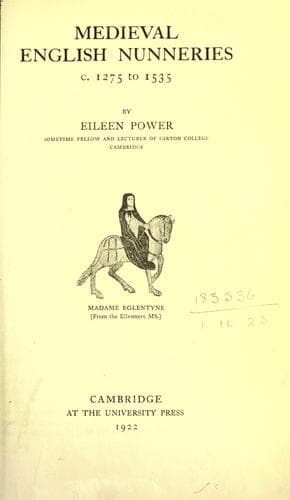
Medieval English Nunneries c. 1275 to 1535 — John Shaqi
Medieval English Nunneries c. 1275 to 1535Power, Eileen
History
Medieval English Nunneries c. 1275 to 1535
Power, Eileen
Convents -- England; Monastic and religious life of women -- History
As early as 1197 there is a case at Ankerwyke, where a nun who had been
fifteen years professed returned to the world and claimed a share of her
father's property, on the ground that she had been forced into the
monastery by a guardian, who wished to secure the whole inheritance. Her
relatives energetically resisted a claim by which they would have been the
losers and appealed to the Pope. The runaway nun was excommunicated and
her case came into the Curia Regis, but the result has not survived and it
is impossible to say whether her story was true[139]. The case of Agnes,
nun of Haverholme, illustrates at once the reason for which an unwilling
girl might be immured in a nunnery and the obstacles which her order would
place in the way of escape. She enters history in a papal mandate of 1304,
by which three ecclesiastics are ordered to take proceedings in the case
of Agnes, whose father and stepmother (how familiar and like a fairy tale
it sounds) in order to deprive her of her heritage, shut her up in the
monastery of Haverholme. "The canons and nuns of Sempringham (to which
order Haverholme belonged) declare," continues the mandate, "that she took
the habit out of devotion, but refuse to confirm their assertion by
oath"[140]. The inference is irresistible. Another case, the memory of
which is preserved in a petition to Chancery, concerns Katherine and Joan,
the two daughters of Thomas Norfolk, whose widow Agnes married a certain
Richard Haldenby. Agnes was seised of certain lands and tenements in
Yorkshire to the value of L40 a year, as the nearest friend of the two
girls, whose share of their father's estate the lands were. But her
remarriage roused the wrath of the Norfolk family and an uncle, John
Norfolk, dispossessed her of the land and took the children out of her
guardianship, "with great force of armed men against the peace of our lord
the king," breaking open their doors and carrying away the deeds of their
possessions. Then, according to the petition of Agnes and her second
husband, "did he make the said Katherine a nun, when she was under the age
of nine years, at a place called Wallingwells, against her will, and the
other daughter of the aforesaid Thomas Norfolk he hath killed, as it is
said." The mother begs for an inquiry to be held[141].
Public-domain text, read in full here on John Shaqi.
Reviews
Reviews
No reviews yet
Be the first to share your thoughts on this work.
Join the Discussion
Join the discussion
Sign in to leave a comment or review.
Sign InorCreate an account