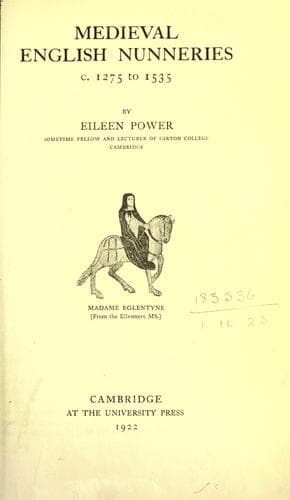
Medieval English Nunneries c. 1275 to 1535Power, Eileen
History
Medieval English Nunneries c. 1275 to 1535
Power, Eileen
Convents -- England; Monastic and religious life of women -- History
But the most vivid of all these little tragedies of the cloister are those
concerned with Margaret de Prestewych and Clarice Stil. The case of
Margaret de Prestewych has been preserved in the register of Robert de
Stretton, Bishop of Coventry and Lichfield; and it is satisfactory to know
that one energetic girl at least succeeded in making good her protests and
in escaping from her prison. In her eighth year or thereabouts, according
to her own petition to the Pope, her friends compelled her against her
will to enter the priory of the nuns of Seton, of the order of St
Augustine, and take on her the habit of a novice. She remained there, as
in a prison, for several years, always protesting that she had never made
nor ever would willingly make any profession. And then, seeing that she
must by profession be excluded from her inheritance, she feigned herself
sick and took to her bed. But this did not prevent her being carried to
the church at the instance of her rivals and blessed by a monk, in spite
of her cries and protests that she would not remain in that priory or in
any other order. On the first opportunity she went forth from the priory
without leave and returned to the world, which in heart she had never
left, and married Robert de Holand, publicly after banns, and had issue.
The bishop, to whom the case had been referred by the Pope, found upon
inquiry that these things were true, and in 1383 released her from the
observance of her order[142].
Within a few years of this high spirited lady's escape the case of little
Clarice Stil engaged the attention of the King's court. The dry-as-dust
pages of the medieval law-books hide many jewels for whoever has patience
to seek them, but none brighter than this story. It all arose out of a
writ of wardship sued by one David Carmayngton or Servyngton against
Walter Reynold, whom he declared to have unjustly deforced him of the
wardship of the land and heir of Robert Stil, the heir being Clarice.
Walter, however, said that no action lay against him, because Clarice had
entered into the order of St John of Jerusalem, of which the Prioress of
Buckland was prioress, and had been professed in that order on the very
day of the purchase of the writ. In answer David unfolded a strange story.
He alleged that William Stil, the father of Robert, had married twice; by
his first wife Constance he had one daughter Margaret, who was now the
wife of Walter Reynold; by his second wife Joan he had two children,
Robert and Clarice. William died seised of certain tenements which were
inherited by Robert, who died without an heir of his body; whereupon
(David alleged) Walter, by connivance with the Prioress of Buckland and in
order to disinherit Clarice (in which case his own wife Margaret would be
the next of kin), took Clarice after her brother's death and conveyed her
to Buckland Priory, she being then eight years of age, and kept her there
under guard. David's counsel gave a dramatic account of the proceeding:
Public-domain text, read in full here on John Shaqi.
Reviews
Reviews
No reviews yet
Be the first to share your thoughts on this work.
Join the Discussion
Join the discussion
Sign in to leave a comment or review.
Sign InorCreate an account