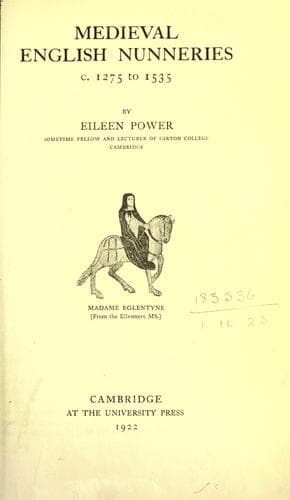
Medieval English Nunneries c. 1275 to 1535Power, Eileen
History
Medieval English Nunneries c. 1275 to 1535
Power, Eileen
Convents -- England; Monastic and religious life of women -- History
But this was by no means the end of the matter. A year later the whole
nunnery was in an uproar[163]. The bishop, for reasons best known to
himself, had removed the prioress Dame Anne Wake and had appointed Dame
Helen Snawe in her place; perhaps Dame Anne had said "Tush" once too
often under the new _regime_; perhaps she was getting too old for her
work; or perhaps Abbess Elizabeth Boifeld had only commanded Dame Snawe's
intrigues at a price; evidently the subsacrist was no less adroit than
that other subsacrist of Bury St Edmund's. At any rate Dame Anne Wake was
put out of her office and Dame Helen Snawe ruled in her stead. It might
have been expected that this change would be welcomed by the nuns,
considering how strong the Boifeld faction had been at the election of the
Abbess. But no; during the year of triumph Helen Snawe had aroused the
hearty dislike of her sisters; led by Dames Barbara Gray (who had voted
against the Abbess at the last election) and Alice Bowlis they had
strenuously opposed her substitution for the old Prioress; they had been
impertinent to the Abbess of their own choice (indeed she was only a
figure-head); they had written letters to their friends and refused to
show them to her; and finally when the election of Dame Snawe was
announced, they had risen in a body and left the chapter-house as a
protest. This was intolerable, and the Bishop's vicar-general came down to
examine the delinquents. Matilda Sheldon, the subprioress, admitted to
having left the chapter, but denied that she had done so for the reason
attributed and said that she did not know of the departure of the other
nuns, until she saw them in the dorter. Margaret Nicolson showed more
spirit; she said that she went out "because she wold not consent that my
lady Snawe shulde be priores," and that "ther was none that ded councell
hir to goo" and that "my lady abbes did commaunde them to tary, that not
withestandyng they went forthe"; and she gave the names of eight nuns who
had followed the subprioress out. Dame Barbara Gray was next asked "yf she
ded aske licence of my Lady Abbas to wryte letters to hir frends," and
replied "that she ded aske licens to wryte to hir frends and my Lady Abbas
sade, 'Yf ye showe me what ye wryte I am content,' and she saide agene, 'I
have done my devoir to aske licence, and yf ye wyll nede see it I will
wryte noo letters.'" Asked whether she had left the chapter house, this
defiant young woman declared that "yf it were to do agene she wolde soo
doo," and moreover "that she cannot fynde in hir hert to obbey my lady
Snawe as priores, and that she wyll rather goo out of the house by my
lord's licence, or she wyll obbey hir ... and that she wyll never obbey
hir as priores, for hir hert cannot serve hir." Asked for her objection to
Dame Snawe, she said that "she wyll shewe noo cause at thys tyme wherfor
she cannot love hir"; but after a little pressure she declared with heat
Public-domain text, read in full here on John Shaqi.
Reviews
Reviews
No reviews yet
Be the first to share your thoughts on this work.
Join the Discussion
Join the discussion
Sign in to leave a comment or review.
Sign InorCreate an account